

-
1 функция поля
-
2 БИБЛИОГРАФИЯ
Мы приняли следующие сокращения для наиболее часто упоминаемых книг и журналов:IJP - International Journal of Psycho-analysisJAPA - Journal of the American Psychoanalytic AssociationSE - Standard Edition of the Complete Psychological Works of Sigmund Freud, ed. James Strachey (London: Hogarth Press and the Institute of Psycho-Analysis, 1953—74.)PSOC - Psychoanalytic Study of the Child (New Haven: Yale University Press)PQ - Psychoanalytic QuarterlyWAF - The Writings of Anna Freud, ed. Anna Freud (New York: International Universities Press, 1966—74)PMC - Psychoanalysis The Major Concepts ed. Burness E. Moore and Bernard D. Fine (New Haven: Yale University Press)\О словаре: _about - Psychoanalytic Terms and Concepts\1. Abend, S. M. Identity. PMC. Forthcoming.2. Abend, S. M. (1974) Problems of identity. PQ, 43.3. Abend, S. M., Porder, M. S. & Willick, M. S. (1983) Borderline Patients. New York: Int. Univ. Press.4. Abraham, K. (1916) The first pregenital stage of libido. Selected Papers. London, Hogarth Press, 1948.5. Abraham, K. (1917) Ejaculatio praecox. In: selected Papers. New York Basic Books.6. Abraham, K. (1921) Contributions to the theory of the anal character. Selected Papers. New York: Basic Books, 1953.7. Abraham, K. (1924) A Short study of the development of the libido, viewed in the light of mental disorders. In: Selected Papers. London: Hogarth Press, 1927.8. Abraham, K. (1924) Manic-depressive states and the pre-genital levels of the libido. In: Selected Papers. London: Hogarth Press, 1949.9. Abraham, K. (1924) Selected Papers. London: Hogarth Press, 1948.10. Abraham, K. (1924) The influence of oral erotism on character formation. Ibid.11. Abraham, K. (1925) The history of an impostor in the light of psychoanalytic knowledge. In: Clinical Papers and Essays on Psychoanalysis. New York: Basic Books, 1955, vol. 2.12. Abrams, S. (1971) The psychoanalytic unconsciousness. In: The Unconscious Today, ed. M. Kanzer. New York: Int. Univ. Press.13. Abrams, S. (1981) Insight. PSOC, 36.14. Abse, D W. (1985) The depressive character In Depressive States and their Treatment, ed. V. Volkan New York: Jason Aronson.15. Abse, D. W. (1985) Hysteria and Related Mental Disorders. Bristol: John Wright.16. Ackner, B. (1954) Depersonalization. J. Ment. Sci., 100.17. Adler, A. (1924) Individual Psychology. New York: Harcourt, Brace.18. Akhtar, S. (1984) The syndrome of identity diffusion. Amer. J. Psychiat., 141.19. Alexander, F. (1950) Psychosomatic Medicine. New York: Norton.20. Allen, D. W. (1974) The Feat- of Looking. Charlottesvill, Va: Univ. Press of Virginia.21. Allen, D. W. (1980) Psychoanalytic treatment of the exhibitionist. In: Exhibitionist, Description, Assessment, and Treatment, ed. D. Cox. New York: Garland STPM Press.22. Allport, G. (1937) Personality. New York: Henry Holt.23. Almansi, R. J. (1960) The face-breast equation. JAPA, 6.24. Almansi, R. J. (1979) Scopophilia and object loss. PQ, 47.25. Altman, L. Z. (1969) The Dream in Psychoanalysis. New York: Int. Univ. Press.26. Altman, L. Z. (1977) Some vicissitudes of love. JAPA, 25.27. American Psychiatric Association. (1987) Diagnostic and Statistical Manual of Mental Disorders, 3d ed. revised. Washington, D. C.28. Ansbacher, Z. & Ansbacher, R. (1956) The Individual Psychology of Alfred Adler. New York: Basic Books.29. Anthony, E. J. (1981) Shame, guilt, and the feminine self in psychoanalysis. In: Object and Self, ed. S. Tuttman, C. Kaye & M. Zimmerman. New York: Int. Univ. Press.30. Arlow. J. A. (1953) Masturbation and symptom formation. JAPA, 1.31. Arlow. J. A. (1959) The structure of the deja vu experience. JAPA, 7.32. Arlow. J. A. (1961) Ego psychology and the study of mythology. JAPA, 9.33. Arlow. J. A. (1963) Conflict, regression and symptom formation. IJP, 44.34. Arlow. J. A. (1966) Depersonalization and derealization. In: Psychoanalysis: A General Psychology, ed. R. M. Loewenstein, L. M. Newman, M. Schur & A. J. Solnit. New York: Int. Univ. Press.35. Arlow. J. A. (1969) Fantasy, memory and reality testing. PQ, 38.36. Arlow. J. A. (1969) Unconscious fantasy and disturbances of mental experience. PQ, 38.37. Arlow. J. A. (1970) The psychopathology of the psychoses. IJP, 51.38. Arlow. J. A. (1975) The structural hypothesis. PQ, 44.39. Arlow. J. A. (1977) Affects and the psychoanalytic situation. IJP, 58.40. Arlow. J. A. (1979) Metaphor and the psychoanalytic situation. PQ, 48.41. Arlow. J. A. (1979) The genesis of interpretation. JAPA, 27 (suppl.).42. Arlow. J. A. (1982) Problems of the superego concept. PSOC, 37.43. Arlow. J. A. (1984) Disturbances of the sense of time. PQ, 53.44. Arlow. J. A. (1985) Some technical problems of countertransference. PQ, 54.45. Arlow, J. A. & Brenner, C. (1963) Psychoanalytic Concepts and the Structural Theory, New York: Int. Univ. Press.46. Arlow, J. A. & Brenner, C. (1969) The psychopathology of the psychoses. IJP, 50.47. Asch, S. S. (1966) Depression. PSOC, 21.48. Asch, S. S. (1976) Varieties of negative therapeutic reactions and problems of technique. JAPA, 24.49. Atkins, N. (1970) The Oedipus myth. Adolescence, and the succession of generations. JAPA, 18.50. Atkinson, J. W. & Birch, D. (1970) The Dynamics of Action. New York: Wiley.51. Bachrach, H. M. & Leaff, L. A. (1978) Analyzability. JAPA, 26.52. Bacon, C. (1956) A developmental theory of female homosexuality. In: Perversions,ed, S. Lorand & M. Balint. New York: Gramercy.53. Bak, R. C. (1953) Fetishism. JAPA. 1.54. Bak, R. C. (1968) The phallic woman. PSOC, 23.55. Bak, R. C. & Stewart, W. A. (1974) Fetishism, transvestism, and voyeurism. An American Handbook of Psychiatry, ed. S. Arieti. New York: Basic Books, vol. 3.56. Balint, A. (1949) Love for mother and mother-love. IJP, 30.57. Balter, L., Lothane, Z. & Spencer, J. H. (1980) On the analyzing instrument, PQ, 49.58. Basch, M. F. (1973) Psychoanalysis and theory formation. Ann. Psychoanal., 1.59. Basch, M. F. (1976) The concept of affect. JAPA, 24.60. Basch, M. F. (1981) Selfobject disorders and psychoanalytic theory. JAPA, 29.61. Basch, M. F. (1983) Emphatic understanding. JAPA. 31.62. Balldry, F. Character. PMC. Forthcoming.63. Balldry, F. (1983) The evolution of the concept of character in Freud's writings. JAPA. 31.64. Begelman, D. A. (1971) Misnaming, metaphors, the medical model and some muddles. Psychiatry, 34.65. Behrends, R. S. & Blatt, E. J. (1985) Internalization and psychological development throughout the life cycle. PSOC, 40.66. Bell, A. (1961) Some observations on the role of the scrotal sac and testicles JAPA, 9.67. Benedeck, T. (1949) The psychosomatic implications of the primary unit. Amer. J. Orthopsychiat., 19.68. Beres, C. (1958) Vicissitudes of superego functions and superego precursors in childhood. FSOC, 13.69. Beres, D. Conflict. PMC. Forthcoming.70. Beres, D. (1956) Ego deviation and the concept of schizophrenia. PSOC, 11.71. Beres, D. (1960) Perception, imagination and reality. IJP, 41.72. Beres, D. (1960) The psychoanalytic psychology of imagination. JAPA, 8.73. Beres, D. & Joseph, E. D. (1965) Structure and function in psychoanalysis. IJP, 46.74. Beres, D. (1970) The concept of mental representation in psychoanalysis. IJP, 51.75. Berg, M D. (1977) The externalizing transference. IJP, 58.76. Bergeret, J. (1985) Reflection on the scientific responsi bilities of the International Psychoanalytical Association. Memorandum distributed at 34th IPA Congress, Humburg.77. Bergman, A. (1978) From mother to the world outside. In: Grolnick et. al. (1978).78. Bergmann, M. S. (1980) On the intrapsychic function of falling in love. PQ, 49.79. Berliner, B. (1966) Psychodynamics of the depressive character. Psychoanal. Forum, 1.80. Bernfeld, S. (1931) Zur Sublimierungslehre. Imago, 17.81. Bibring, E. (1937) On the theory of the therapeutic results of psychoanalysis. IJP, 18.82. Bibring, E. (1941) The conception of the repetition compulsion. PQ, 12.83. Bibring, E. (1953) The mechanism of depression. In: Affective Disorders, ed. P. Greenacre. New York: Int. Univ. Press.84. Bibring, E. (1954) Psychoanalysis and the dynamic psychotherapies. JAPA, 2.85. Binswanger, H. (1963) Positive aspects of the animus. Zьrich: Spring.86. Bion Francesca Abingdon: Fleetwood Press.87. Bion, W. R. (1952) Croup dynamics. IJP, 33.88. Bion, W. R. (1961) Experiences in Groups. London: Tavistock.89. Bion, W. R. (1962) A theory of thinking. IJP, 40.90. Bion, W. R. (1962) Learning from Experience. London: William Heinemann.91. Bion, W. R. (1963) Elements of Psychoanalysis. London: William Heinemann.92. Bion, W. R. (1965) Transformations. London: William Heinemann.93. Bion, W. R. (1970) Attention and Interpretation. London: Tavistock.94. Bion, W. R. (1985) All My Sins Remembered, ed. Francesca Bion. Adingdon: Fleetwood Press.95. Bird, B. (1972) Notes on transference. JAPA, 20.96. Blanck, G. & Blanck, R. (1974) Ego Psychology. New York: Columbia Univ. Press.97. Blatt, S. J. (1974) Levels of object representation in anaclitic and introjective depression. PSOC, 29.98. Blau, A. (1955) A unitary hypothesis of emotion. PQ, 24.99. Bleuler, E. (1911) Dementia Praecox or the Group of Schizophrenias. New York: Int. Univ. Press, 1951.100. Blos, P. (1954) Prolonged adolescence. Amer. J. Orthopsychiat., 24.101. Blos, P. (1962) On Adolescence. New York: Free Press.102. Blos, P. (1972) The epigenesia of the adult neurosis. 27.103. Blos, P. (1979) Modification in the traditional psychoanalytic theory of adolescent development. Adolescent Psychiat., 8.104. Blos, P. (1984) Son and father. JAPA_. 32.105. Blum, G. S. (1963) Prepuberty and adolescence, In Studies ed. R. E. Grinder. New York: McMillan.106. Blum, H. P. Symbolism. FMC. Forthcoming.107. Blum, H. P. (1976) Female Psychology. JAPA, 24 (suppl.).108. Blum, H. P. (1976) Masochism, the ego ideal and the psychology of women. JAPA, 24 (suppl.).109. Blum, H. P. (1980) The value of reconstruction in adult psychoanalysis. IJP, 61.110. Blum, H. P. (1981) Forbidden quest and the analytic ideal. PQ, 50.111. Blum, H. P. (1983) Defense and resistance. Foreword. JAFA, 31.112. Blum, H. P., Kramer, Y., Richards, A. K. & Richards, A. D., eds. (1988) Fantasy, Myth and Reality: Essays in Honor of Jacob A. Arlow. Madison, Conn.: Int. Univ. Press.113. Boehm, F. (1930) The femininity-complex In men. IJP,11.114. Boesky, D. Structural theory. PMC. Forthcoming.115. Boesky, D. (1973) Deja raconte as a screen defense. PQ, 42.116. Boesky, D. (1982) Acting out. IJP, 63.117. Boesky, D. (1986) Questions about Sublimation In Psychoanalysis the Science of Mental Conflict, ed. A. D. Richards & M. S. Willick. Hillsdale, N. J.: Analytic Press.118. Bornstein, B. (1935) Phobia in a 2 1/2-year-old child. PQ, 4.119. Bornstein, B. (1951) On latency. PSOC, 6.120. Bornstein, M., ed. (1983) Values and neutrality in psychoanalysis. Psychoanal. Inquiry, 3.121. Bowlby, J. (1960) Grief and morning in infancy and early childhood. PSOC. 15.122. Bowlby, J. (1961) Process of mourning. IJP. 42.123. Bowlby, J. (1980) Attachment and Loss, vol. 3. New York: Basic Books.124. Bradlow, P. A. (1973) Depersonalization, ego splitting, non-human fantasy and shame. IJP, 54.125. Brazelton, T. B., Kozlowsky, B. & Main, M. (1974) The early motherinfant interaction. In: The Effect of the Infant on Its Caregiver, ed. M. Lewis & L. Rosenblum New York Wiley.126. Brenner, C. (1957) The nature and development of the concept of repression in Freud's writings. PSOC, 12.127. Brenner, C. (1959) The masochistic character. JAPA, 7.128. Brenner, C. (1973) An Elementary Textbook of Psycho-analysis. New York Int. Univ. Press.129. Brenner, C. (1974) On the nature and development of affects PQ, 43.130. Brenner, C. (1976) Psychoanalytic Technique and Psychic Conflict. New York: Int. Univ. Press.131. Brenner, C. (1979) The Mind in Conflict. New York: Int. Univ. Press.132. Brenner, C. (1979) Working alliance, therapeutic alliance and transference. JAPA, 27.133. Brenner, C. (1981) Defense and defense mechanisms. PQ, 50.134. Brenner, C. (1983) Defense. In: the Mind in Conflict. New York Int. Univ. Press.135. Bressler, B. (1965) The concept of the self. Psychoanalytic Review, 52.136. Breuer, J. & Freud, S. (1983—95) Studies on Hysteria. SE, 3.137. Breznitz, S., ed. (1983) The Denial of Stress. New York: Int. Univ. Press.138. Brody, S. (1964) Passivity. New York: Int. Univ. Press.139. Brown, H. (1970) Psycholinquistics. New York: Free Press.140. Bruner, J. S. (1964) The course of cognitive growth. Amer. Psychologist. 19.141. Bruner, J., Jolly, A. & Sylva, K. (1976) Play. New York Basic Books.142. Bruner, J. E., Olver, R. R. &Greenfield, P. M. (1966) Studies in Cognitive Growth. New York: Wiley.143. Buie, D H. (1981) Empathy. JAPA, 29.144. Burgner, M. & Edgeumble, R. (1972) Some problems in the conceptualization of early object relationships. PSOC, 27.145. Call, J. ed. (1979) Basic Handbook of Child Psychiatry. New York: Basic Books.146. Carroll, G. (1956) Language, Thought and Reality. Cambridge & London: M. I. T. Press & John Wiley.147. Cavenar, J. O. & Nash, J. L. (1976) The effects of Combat on the normal personality. Comprehensive Psychiat., 17.148. Chassequet-Smirgel, J. (1978) Reflections on the connection between perversion and sadism. IJP, 59.149. Chomsky, N. (1978) Language and unconscious knowledge. In: Psychoanalysis and Language, ed. J. H. Smith. New Haven: Yale Univ. Press, vol. 3.150. Clower, V. (1975) Significance of masturbation in female sexual development and function. In: Masturbation from Infancy to Senescence, ed. I. Marcus & J. Francis. New York: Int. Uni" Press.151. Coen, S. J. & Bradlow, P. A. (1982) Twin transference as a compromise formation. JAPA, 30.152. Compton, A. Object and relationships. PMC. Forthcoming.153. Cullen, W. (1777) First Lines of the Practice of Psysic. Edinburgh: Bell, Brandfute.154. Curtis, B. C. (1969) Psychoanalytic understanding and treatment of impotence. In: Sexual Function and Dysfunction, ed. P. J. Fink & V. B. O. Hummett. Philadelphia: F. A. Davis.155. Darwin, C. (1874) The Descent of Man. New York: Hurst.156. Davidoff-Hirsch, H. (1985) Oedipal and preoedipal phenomena. JAPA, 33.157. Davis, M. & Wallbridge, D. (1981) Boundary and Space. New York: Brunner-Mazel.158. Deutsch, H. (1932) Homosexuality in women. PQ, 1.159. Deutsch, H. (1934) Some forms of emotional disturbance and their relationship to schizophrenia. PQ, 11.160. Deutsch, H. (1937) Absence of grief. PQ, 6.161. Deutsch, H. (1942) Some forms of emotional disturbance and their relationship to schizophrenia. PQ, 11.162. Deutsch, H. (1955) The impostor. In: Neuroses and Character Types. New York: Int. Univ. Press, 1965.163. Devereux, G. (1953) Why Oedipus killed Lains. IJP, 34.164. Dewald, P. (1982) Psychoanalytic perspectives On resistance. In: resistance, Psychodynamics. and Behavioral Approaches, ed. P. Wachtel. New York: Plenum Press.165. Dickes, R. (1963) Fetishistic behavior. JAPA. 11.166. Dickes, R. (1965) The defensive function of an altered state of consciousness. JAPA, 13.167. Dickes, R. (1967) Severe regressive disruption of the therapeutic alliance. JAPA, 15.168. Dickes, R. (1981) Sexual myths and misinformation. In: Understanding Human Behaviour in Health and Illness, ed. R. C. Simon & H. Pardes. Baltimore: Williams & Wilkins.169. Dorpat, T. L. (1985) Denial and Defense in the Therapeutic Situation. New York: Jason Aronson.170. Downey, T. W. (1978) Transitional phenomena in the analysis of early adolescent males. PSOC, 33.171. Dunbar, F. (1954) Emotions and Bodily Functions. New York: Columbia Univ. Press.172. Easson, W. M. (1973) The earliest ego development, primitive memory traces, and the Isakower phenomenon. PQ, 42.173. Edelheit, H. (1971) Mythopoiesis and the primal scene. Psychoanal. Study Society, 5.174. Edgcumbe, R. & Burgner, M. (1972) Some problems in the conceptualization of early object relation ships, part I. PSOC, 27.175. Edgcumbe, R. & Burgner, M. (1975) The phallicnarcissistic phase. PSOC, 30.176. Eidelberg, L. (1960) A third contribution to the study of slips of the tongue. IJP, 41.177. Eidelberg, L. (1968) Encyclopedia of Psychoanalysis. New York: The Free Press; London: Collier-MacMillan.178. Eissler, K. R. (1953) The effect of the structure of the ego on psychoanalytic technique. JAPA, 1.179. Ellenberg, H. F. (1970) The Discovery of the Unconscious. New York: Basic Books.180. Emde, R. N. (1980) Toward a psychoanalytic theory of affect: I. & G. H. Pollock. Washington NYMH.181. Emde R., Gaensbaner, T. & Harmon R. (1976) Emotional Expression in Infancy. New York: Int. Univ. Press.182. Erode R. & Harmon, R. J. (1972) Endogenous and exogenous smiling systems in early infancy. J. Amer. Acad. Child Psychiat., 11.183. Engel, G. L. (1962) Psychological Development in Health and Disease. New York Saunders.184. Engel, G. L. (1967) Psychoanalytic theory of somatic disorder. JAPA, 15.185. Engel, G. L. (1968) A reconsideration of the role of conversion in somatic disease. Compr. Psychiat., 94.186. English, H. B. & English, A. C. (1958) A comprehensive Dictionary of Psychological and Psychoanalytical Terms. New York: David McKay.187. Erard, R. (1983) New wine in old skins. Int. Rev. Psychoanal., 10.188. Erdelyi, M. H. (1985) Psychoanalysis. New York: W. H. Freeman.189. Erikson, E. H. (1950) Childhood and Society. New York: Norton.190. Erikson, E. H. (1956) The concept of ego identity. JAPA, 4.191. Erikson, E. H. (1956) The problem of ego identity. JAPA, 4.192. Esman, A. H. (1973) The primal scene. PSOC, 28.193. Esman, A. H. (1975) The Psychology of Adolescence. New York: Int. Univ. Press.194. Esman, A. H. (1979) Some reflections on boredom. JAPA, 27.195. Esman, A. H. (1983) The "stimulus barrier": a review and reconsideration. PSOC, 38.196. Fairbairn, W. R. D. (1952) Psychoanalytic Studies of the Personality. London: Routledge & Kegan Paul.197. Fairbairn, W. R. D. (1954) An Object-Relations Theory of the Personality. New York: Basic Books.198. Fairbairn, W. R. D. (1963) Synopsis of an Object-Relations theory of the personality. IJP, 44.199. Fawcett, J., Clark, D. C., Scheftner, W. H. & Hedecker, D. (1983) Differences between anhedonia and normal hedonic depressive states. Arch. Gen. Psychiat., 40.200. Fenichel, O. (1934) On the psychology of boredom. Collected Papers. New York: Norton, 1953, vol. 1.201. Fenichel, O. (1941) Problems of Psychoanalytic Technique. Albany, N. Y.: Psychoanalytic Quaterly.202. Fenichel, O. (1945) Character disorders. In: The Psychoanalytic Theory of the Neurosis. New York: Norton.203. Fenichel, O. (1945) The Psychoanalytic Theory of Neurosis New York: Norton.204. Fenichel, O. (1954) Ego strength and ego weakness. Collected Papers. New York: Norton, vol. 2.205. Ferenczi, S. (1909) Introjection and transference. In: Sex in Psychoanalysis. New York: Basic Books.206. Ferenczi, S. (191617) Disease or patho-neurosis. The Theory and Technique of Psychoanalysis. London: Hogarth Press, 1950.207. Ferenczi, S. (1925) Psychoanalysis of sexual habits. In: The Theory and Technique of Psychoanalysis. New York: Basic Books.208. Fine, B. D., Joseph, E. D. & Waldhorn, H. F., eds. (1971) Recollection and Reconstruction in Psychoanalysis. Monograph 4, Kris Study Group. New York: Int. Univ. Press.209. Fink, G. (1967) Analysis of the Isakower phenomenon. JAPA, 15.210. Fink, P. J. (1970) Correlation between "actual" neurosis and the work of Masters and Johson. P. Q, 39.211. Finkenstein, L. (1975) Awe premature ejaculation. P. Q, 44.212. Firestein, S. K. (1978) A review of the literature. In: Termination in Psychoanalysis. New York: Int. Univ. Press.213. Fisher, C. et. al. (1957) A study of the preliminary stages of the construction of dreams and images. JAPA, 5.214. Fisher, C. et. al. (1968) Cycle of penile erection synchronous with dreaming (REM) sleep. Arch. Gen. Psychiat., 12.215. Fliess, R. (1942) The metapsychology of the analyst. PQ, 12.216. Fliess, R. (1953) The Revival of Interest in the Dream. New York: Int. Univ. Press.217. Fodor, N. & Gaynor, F. (1950) Freud: Dictionary of Psycho-analysis. New York: Philosophical Library.218. Fordham, M. (1969) Children as Individuals. London: Hodder & Stoughton.219. Fordham, M. (1976) The Self and Autism. London: Academic Press.220. Fraiberg, S. (1969) Object constancy and mental representation. PSOC, 24.221. Frank, A. Metapsychology. PMS. Forthcoming.222. Frank, A. & Muslin, H. (1967) The development of Freud's concept of primal repression. PSOC, 22.223. Frank, H. (1977) Dynamic patterns for failure in college students. Can. Psychiat. Ass. J., 22.224. French, T. & Fromm, E. (1964) Dream Interpretation. New York: Basic Books.225. Freud, A. (1936) The Ego and the Mechanisms of Defense. New York Int. Univ. Press.226. Freud, A. (1951) Observations on child development. PSOC, 6.227. Freud, A. (1952) The mutual influences in the development of ego and id. WAF, 4.228. Freud, A. (1958) Adolescence. WAF, 5.229. Freud, A. (1962) Assessment of childhood disturbances. PSOC, 17.230. Freud, A. (1962) Comments on psychic trauma. In: Furst (1967).231. Freud, A. (1963) The concept of developmental lines. PSOC, 18.232. Freud, A. (1965) Assessment of pathology, part 2. WAF, 6.233. Freud, A. (1965) Normality and Pathology in Childhood. New York: Int. Univ. Press.234. Freud, A. (1970) The infantile neurosis. WAF, 7.235. Freud, A. (1971) Comments on aggression. IJP, 53.236. Freud, A. (1971) The infantile neurosis. PSOC, 26.237. Freud, A. (1981) Insight. PSOC, 36.238. Freud, S. (1887—1902) Letters to Wilhelm Fliess. New York: Basic Books, 1954.239. Freud, S. (1891) On the interpretation of the aphasias. SE, 3.240. Freud, S. (1893—95) Studies on hysteria. SE, 2.241. Freud, S. (1894) The neuropsychoses of defence. SE, 3.242. Freud, S. (1895) On the ground for detaching a particular syndrome from neurasthenia under the description "anxiety neurosis". SE, 3.243. Freud, S. (1895) Project for a scientific psychology. SE, 1.244. Freud, S. (1896) Draft K, Jameary 1, 1896, Neuroses of defense (A Christmas fairytale). In: Extracts from the Fliess papers (1892—99).245. Freud, S. (1896) Further remarks on the neuropsychosis of defense. SE, 3.246. Freud, S. (1896) Heredity and aetiology of neurosis. SE, 3.247. Freud, S. (1898) Sexuality in the aetiology of the neurosis. SE, 3.248. Freud, S. (1899) Screen memories. SE, 3.249. Freud, S. (1900) The interpretation of dreams. SE, 4—5.250. Freud, S. (1901) Childhood memories and screen memories SE, 6.251. Freud, S. (1901) On dreams. SE, 5.252. Freud, S. (1901) The psychopathology of everyday life. SE, 6.253. Freud, S. (1905) Fragments of an analysis of a case of hysteria. SE, 7.254. Freud, S. (1905) Jokes and their relation to the unconscious. SE, 8.255. Freud, S. (1905) Psysical (or mental) treatment. SE, 7.256. Freud, S. (1905) Three essays on the theory of sexuality. SE. 7.257. Freud, S. (1908) Character and anal erotism. SE, 9.258. Freud, S. (1908) On the sexual theories of children. SE, 9.259. Freud, S. (1908) Preface to Wilhelm Stekel's Nervous Anxiety-States and Their Treatment. SE, 9.260. Freud, S. (1909) Analysis of a phobia in a five-year-old boy. SE, 10.261. Freud, S. (1909) Family romances. SE, 9.262. Freud, S. (1909) Notes upon a case of obsessional neurosis. SE, 10.263. Freud, S. (1910) A special type of choice of object made by men. SE, 11.264. Freud, S. (1910) The autithentical meaning of primal words. SE, 11.265. Freud, S. (1910) The future prospects of psychoanalytic therapy. SE, 11.266. Freud, S. (1910) The psychoanalytic view of psychogenic disturbance of vision. SE, 11.267. Freud, S. (1911) Formulations on the two principles of mental functioning. SE, 12.268. Freud, S. (1911) Notes on a case of paranoia. SE, 12.269. Freud, S. (1911) Psychoanalytic notes on an autobiographical account of a case of paranoia. SE, 12.270. Freud, S. (1911—15) Papers on technique. SE, 12.271. Freud, S. (1912) Contribution to a discussion on masturbation. SE, 12.272. Freud, S. (1912) On the universal tendency to abasement in the sphere of love. SE, 11.273. Freud, S. (1912) The dynamics of transference. SE, 12.274. Freud, S. (1913) Editor's note The disposition to obsessional neurosis. SE, 12.275. Freud, S. (1913) On beginning the treatment. SE, 12.276. Freud, S. (1913) Totem and taboo. SE, 13.277. Freud, S. (1914) Fausse reconnaissance (deja reconte) in psychoanalytic treatment. SE, 13.278. Freud, S. (1914) Mourning and melancholia. SE, 15.279. Freud, S. (1914) Observations on transference love. SE, 12.280. Freud, S. (1914) On narcissism. SE. 14.281. Freud, S. (1914) On the history of the psychoanalytic movement. SE, 14.282. Freud, S. (1914) Remembering, repeating, and working-through. SE, 12.283. Freud, S. (1914—16) Some character types met with in psychoanalysis. (II) Those wrecked by success SE, 14.284. Freud, S. (1915) Das UnbewuЯte. Gesammelte Werke, 10.285. Freud, S. (1915) Instincts and their vicissitudes. SE, 14.286. Freud, S. (1915) Observation on transference-love. SE, I2.287. Freud, S. (1915) Repression. SE, 14.288. Freud, S. (1915) The unconscious. SE, 14.289. Freud, S. (1915—17) Introductory lectures on psychoanalysis. SE, 15 & 16.290. Freud, S. (1916) Introductory lectures on psychoanalysis. SE, 16.291. Freud, S. (1916) Some character types met with in psychoanalytic work. SE, 16.292. Freud, S. (1917) A metapsychological supplement to the theory of dreams. SE, 14.293. Freud, S. (1917) Introductory lectures on psychoanalysis. SE, 16.294. Freud, S. (1917) Mourning and melancholia. SE, 14.295. Freud, S. (1917) On transformations of instinct as exemplified in anal erotism. SE, 17.296. Freud, S. (1918) From the history of an infantile neurosis. SE, 17.297. Freud, S. (1919) "A child is being beaten". SE, 17.298. Freud, S. (1919) Lines of advance in psychoanalytic therapy. SE, 17.299. Freud, S. (1919) The uncanny. SE, 17.300. Freud, S. (1920) Beyond the pleasure principle. SE, 18.301. Freud, S. (1920) The Psychogenesis of a case of homosexuality in a woman. SE, 18.302. Freud, S. (1921) Group psychology and the analysis of the ego. SE, 18.303. Freud, S. (1923) The ego and the id. SE, 19.304. Freud, S. (1923) The infantile genital organization. SE, 19.305. Freud, S. (1924) A short account of psychoanalysis. SE, 19.306. Freud, S. (1924) Neurosis and psychosis. SE, 19.307. Freud, S. (1924) The dissolution of the Oedipus complex SE, 19.308. Freud, S. (1924) The economic problem of masochism. SE, 19.309. Freud, S. (1924) The loss of reality in neurosis and psychosis. SE, 19.310. Freud, S. (1925) Negation. SE, 19.311. Freud, S. (1925) Some psychical consequences of the anatomical distinction between the sexes. SE, 19.312. Freud, S. (1926) Inhibitions, symptoms and anxiety. SE, 20.313. Freud, S. (1926) The question of lay analysis. SE, 20.314. Freud, S. (1927) Fetishism. SE, 21.315. Freud, S. (1930) Civilization and its discontents. SE, 21.316. Freud, S. (1931) Female sexuality. SE, 21.317. Freud, S. (1931) Libidinal types. SE, 21.318. Freud, S. (1933) Femininity. SE, 22,.319. Freud, S. (1933) New introductory lectures on psycho-analysis. SE, 22.320. Freud, S. (1933) The psychology of women. New introductory lectures on psychoanalysis. SE, 22.321. Freud, S. (1936) A disturbance of memory on the Acropolis. SE, 22.322. Freud, S. (1937) Analysis terminable and interminable. SE, 23.323. Freud, S. (1937) Constructions in analysis. SE, 23.324. Freud, S. (1938) An outline on psychoanalysis. SE, 23.325. Freud, S. (1938) Splitting of the ego in the process of defense. SE, 23.326. Freud, S. (1939) Moses and monotheism. SE, 23.327. Freud, S. (1940) An outline of psychoanalysis. SE, 23.328. Frosch, J. (1966) A note on reality constancy. In: Psychoanalysis — A General Psychology, ed. R. M. Loewenstein, L. M. Newman, M. Schur & A. J. Solnit. New York: Int. Univ. Press.329. Frosch, J. (1967) Delusional fixity sense of conviction and the psychotic conflict. IJP, 48.330. Frosch, J. (1977) The relation between acting out and disorders of impulse control. Psychiatry, 40.331. Frosch, J. (1980) Neurosis and psychosis. In: The Course of Life, ed. S. J. Greenspan & G. H. Pollock. Washington, D. C.: National Institute of Health, vol. 3.332. Frosch, J. (1983) The Psychotic Process. New York: Int. Univ. Press.333. Furer, M. (1972) The history of the superego concept in psychoanalysis. In: Moral Value and the Superego concept in Psychoanalysis, ed. S. C. Fost. New York: Int. Univ. Press.334. Furman, E. (1974) A Child s Parent Dies. New Heaven: Yale Univ. Press.335. Furman, E. (1980) Transference and externalization. PSOC, 35.336. Furst, S. Trauma. PMC, Forthcoming.337. Furst, S. (1967) Psychic trauma. In: Psychic Trauma, ed. S. S. Furst. New York: Basic Books.338. Furst, S. (1978) The stimulus barrier and the pathogenecity of trauma. IJP, 59.339. Gaddini, R. (1978) Transitional object and the psychosomatic symptom. In: Grolnich et. al. (1978).340. Galenson, E. & Roiphe, H. (1976) Some suggested revisions concerning early female development. JAPA, 24(5).341. Galenson, E. & Roiphe, H. (1980) The preoedipal development of the boy. JAPA, 28.342. Galenson, E. & Roiphe, H. (1981) Infantile Origins of Sexual Identity. New York: Int. Univ. Press.343. Ganzarain, R. Group psychology. PMC. Forthcoming.344. Ganzarain, R. (1980) Psychotic-like anxieties and primitive defenses. Issues on Ego Psychology, 3(2).345. Ganzarain, R. (1988) A comparative study of Bion's concepts about groups. In: Object Relations Group Psychotherapy. Madison, Ct.: Int. Univ. Press.346. Gediman, H. K. (1971) The concept of the stimulus barrier. IJP, 52.347. Gedo, J. & Goldberg, A. (1973) Models of the Mind. Chicago & London: Univ. of Chicago Press.348. Geerts, A. E. & Prechardt, E., reporters (1978) Colloquium on "trauma". IJP, 59.349. Gero, G. (1943) The idea of psychogenesis in modern psychiatry and in psychoanalysis. Psychoanal. Rev., 30.350. Gill. M. M. (1963) Topography and Systems in Psychoanalytic Theory. Psychol. Issues, Monogr. 10. New York: Int. Univ. Press.351. Gill. M. M. (1967) The primary process in motives and thought. In: Motives and Thought, ed. R. R. Holt. New York: Int. Univ. Press.352. Gill. M. M. (1974) Psychoanalysis and psychotherapy. Int. Rev. Psychoanal., 11.353. Gill, M. M & Rapaport, D. (1942) A case of amnesia and its bearing on the theory of memory. Character and Personality, 11.354. Gillespie, W. (1956) The general theory of Sexual perversion. IJP, 37.355. Glenn, J. (in press) A parameter. In: Annu. Psychoanal.356. Glenn, J. & Kaplan, E. H. (1968) Types of orgasm in women. JAPA, 16.357. Glower, E. (1929) The "screening" function of traumatic memories. IJP, 4.358. Glower, E. (1931) Sublimation, substitution, and social anxiety. IJP, 12.359. Glower, E. (1933) The relation of perversion-formation to the development of reality sense. IJP, 14.360. Glower, E. (1955) The terminal phase. In: The Technique of Psychoanalysis. New York: Int. Univ. Press.361. Goldberg, A. (1975) The evolution of psychoanalytic concepts of depression. In: Depression and Human Existence, ed. E. J. Anthony & T. Benedeck. Boston: Little, Brown.362. Goldberg, A. ed. (1978) The Psychology of the Self. New York: Int. Univ. Press.363. Goldberg, A. (1983) Self psychology and alternate perspectives on internalization. In: Reflections on Self Psychology, ed. J. Lichtenberg & S. Kaplan. Hillsdale, N. J.: Analytic Press.364. Green, A. (1978) Potential space in Psychoanalysis. In: Grolnich et. al. (1978).365. Greenacre, P. (1949) A contribution to the study of screen memories. FSOC, 3/4.366. Greenacre, P. (1950) General problems of acting out. PQ, 19.367. Greenacre, P. (1950) Special problems of early female sexual development. In: Trauma, Growth and Personality New York: Int. Univ. Press.368. Greenacre, P. (1952) Pregenital patterning. IJP, 33.369. Greenacre, P. (1953) Penis awe and its relation to penis envy. In: Drives, Affects, Behavior, ed. R. M. Loewenstein. New York: Int. Univ. Press.370. Greenacre, P. (1956) Experiences of awe in childhood. PSOC,11.371. Greenacre, P. (1957) The childhood of the artist. PSOC, 12.372. Greenacre, P. (1958) The family romance of the artist. In: Emotional Growth. New York: Int. Univ. Press, 1971, vol. 2.373. Greenacre, P. (1958) The relation of the impostor to the artist. In: Emotional Growth. New York: Int. Univ. Press, 1971, vol. 1.374. Greenacre, P. (1968) Perversions. PSOC, 23.375. Greenacre, P. (1969) The fetish and the transitional object, part 1. PSOC, 24.376. Greenacre, P. (1970) The fetish and the transitional object, part 2. IJP 51, vol. 4.377. Greenacre, P. (1970) The transitional object and the fetish. In: Emotional Growth. New York: Int. Univ. Press.378. Greenacre, P. (1972) Crowds and crisis. PSOC, 27.379. Greenacre, P. (1973) The primal scene and the sense of reality. PQ, 42.380. Greenacre, P. (1975) On reconstruction. JAPA, 21.381. Greenberg, J. R. & Mitchell, S. A. (1983) Object Relations in Psychoanalytic Theory. Cambridge: Harvard Univ. Press.382. Greenson, R. R. (1949) The psychology of apathy. PQ, 18.383. Greenson, R. R. (1953) On boredom. JAPA, 1.384. Greenson, R. R. (1960) Empathy and its vicissitudes. IJP, 41.385. Greenson, R. R. (1962) On enthusiasm. JAPA, 10.386. Greenson, R. R. (1965) The working alliance and the transference neurosis. PQ, 34.387. Greenson, R. R. (1967) The technique and Practice of Psycho-analysis. New York: Int. Univ. Press.388. Greenson, R. R. (1978) Exploration in Psychoanalysis. New York: Int. Univ. Press.389. Greenspan, S. & Pollock, G., eds. (1980) The Course of Life. Vol. I. Washington, D. C.: U. S. Government Printing office.390. Grinberg, L., Sor, D. & Tabak de Bianchedi, E. (1975) Introduction to the Work of Bion, trans. A. Hahn. Scotland: Clunie Press.391. Grinker, E. R (1945) Psychiatric disorders in combat crews overseas and in returnees. Med. Clin. North. Amer., 29.392. Grinstein, A. (1983) Freud's Rules of Dream Interpretation. New York: Int. Univ. Press.393. Grolnick, S., Barkin, L. & Muensterberger, W., eds. (1978) Between Reality and Fantasy. New York: Jason Aronson.394. Grosskurth, P. (1986) Melanie Klein. New York: Alfred Knopf.395. Grossman, W. E. & Stewart, W. A. (1976) Penis envy. JAPA, 24 (5).396. Grotstein, J. S. (1981) Splitting and Projective Indentification. New York: Jason Aronson.397. Guntrip, H. (1961) Personality Structure and Human Interaction. New York: Int. Univ. Press.398. Guntrip, H. (1968) Schizoid Phenomena, Object-Relations and the Self. London: Hogarth Press.399. Harley, M. (1967) Transference developments in a five-year old child. In: the Child Analyst at Work, ed. E. Geleerd. New York: Int. Univ. Press.400. Harley, M. (1974) Analyst and Adolescent at Work. New York: Quadrangle.401. Harley, M. (1986) Child analysis, 1947—1984, a retrospective. PSOC, 41.402. Harre, R. and Lamb, R. (1983) The Encyclopedia Dictionary of Psychology. Cambridge: M. I. T. Press.403. Harrison, J. B. (1975) On the maternal origins of awe. PSOC, 30.404. Harrison, J. B. (1979) On Freud's view of the infant-mother relationship and of the oceanic feeling. JAPA, 27.405. Harrison, S. J. (1970) Is psychoanalysis "our science?". JAPA, 18.406. Hartmann, H. PSOC, 5.407. Hartmann, H. (1937) Ego Psychology and the Problem of Adaptation. New York: Int. Univ. Press.408. Hartmann, H. (1939) Ego Psychology and the Problem of Adaptation. New York: Int. Univ. Press, 1958.409. Hartmann, H. (1939) Psychoanalysis and the concept of health. In: Hartmann (1964).410. Hartmann, H. (1947) On rational and irrational action. In: Essays on Ego Psychology. New York: Int. Univ. Press, 1964.411. Hartmann, H. (1948) Comments on the theory of instinctual drives. PQ, 17.412. Hartmann, H. (1950) Comments on the psychoanalytic theory of the ego. New York: Int. Univ. Press.413. Hartmann, H. (1951) Technical implications of ego psychology PQ, 20.414. Hartmann, H. (1952) The mutual influences in the development of ego and id. PSOC, 7.415. Hartmann, H. (1953) Contribution to the metapsychology of schizophrenia. In: Hartmann, PSOC, 8.416. Hartmann, H. (1953) The metapsychology of schizophrenia. PSOC, 8.417. Hartmann, H. (1955) Notes on the theory of sublimation. PSOC, 10.418. Hartmann, H. (1956) The development of the ego concept in Freud's work. IJP, 37.419. Hartmann, H. (1964) Essays in Ego Psychology. New York Int. Univ. Press.420. Hartmann, H. (1964) The development of the ego concept in Freud's work. IJP, 37.421. Hartmann, H., Kris, E. & Loewenstein, R. M. (1946) Comments in the formation of psychic structure. PSOC, 2.422. Hartmann, H., Kris, E. & Loewenstein, R. M. (1949) Notes on the theory of aggression. PSOC, 3/4.423. Hartmann, H. & Loewenstein, R. M. (1962) Notes on the superego. PSOC, 17.424. Hassler, A. D. (1960) Guideposts of migrating fish. Science, 122.425. Hastings, D. W. (1963) Impotence and Frigidity. Boston: Little, Brown.426. Heimann, P. (1952) Certain functions of introjection and projection in early infancy. In: Klein et al. (1952).427. Heimann, P. & Valenstein, A. F. (1962) Notes on the anal stage IJP, 43.428. Heimann, P. & Valenstein, A. F. (1972) The psychoanalytical concept of aggression. IJP, 53.429. Hendrick, I. (1958) Facts and Theories of Psychoanalysis, 3rd ed. New York: Alfred Knopf.430. Hill, M. (1982) Analysis of transference. In: Theory and Technique, vol. 1. New York: Int. Univ. Press.431. Hoffer, W. (1949) Mouth, hand, and ego integration. PSOC, 3/4.432. Holder, A. (1982) Preoedipal contributions to the formation of the superego. PSOC, 37.433. Holt, R. R. (1964) The emergence of cognitive psychology JAPA, 12.434. Holt, R. R. (1967) Beyond vitalism and mechanism. In: Science and Psychoanalysis, ed. J. H. Masserman. Hew York: Grune & Stratton, vol. 2.435. Hook, S. (1959) Psychoanalysis, Scientific Method and Philosophy. New York: Grove Press.436. Horney, K. (1924) On the genesis of the castration complex in women. IJP, 5.437. Horney, K. (1926) The flight from womanhood. IJP, 7.438. Horowitz, M. J. (1972) Modes of representation of thought. JAFA, 20.439. Horowitz, M. J. (1979) States of Mind, 2d. ed. New York: Plenum, 1987, chap. 3.440. Hurvich, M. (1970) On the concept of reality testing. IJP, 51.441. Isaacs, S. (1952) The nature and function of phantasy. In: Klein et. al. (1952).442. Isakower, O. (1938) A contribution to the pathopsychology of phenomena associated with falling asleep. IJP, 19.443. Isakower, O. (1963) Minutes of the faculty meeting. New York Psychoanalytic Institute, Oct. 14—Nov. 20. A. Z. Pteffer, reporter.444. Isay, R. A. (1986) Homosexuality in homosexual and heterosexual men. In: The Psychology of Men, ed. G. Fogel, F. Lane & R. Liebert. New York: Basic Books.445. Jacobi, J. (1959) Complex (Archetype) Symbol in the Work of C. G. Jung. Princeton, N. J.: Princeton Univ. Press.446. Jacobs, T. J. (1986) Transference relationships, relationships between transferences and reconstruction. In: Psycho-analysis, the Science of Mental Conflict, ed. A. D. Richards & M. S. Willick. Hillsdale N. J.: Analytic Press.447. Jacobson, E. (1953) Contribution to the metapsychology of cyclothymic depression. In: Affective Disorders, ed. P. Greenacre. New York: Int. Univ. Press.448. Jacobson, E. (1954) Contribution to the metapsychology of psychotic identifications. JAPA, 2.449. Jacobson, E. (1957) Normal and pathological moods. PSOC, 12.450. Jacobson, E. (1959) Depersonalization. JAPA, 7.451. Jacobson, E. (1964) The Self and the Object World. New York: Int. Univ. Press.452. Jacobson, E. (1967) Psychotic Conflict and Reality. New York: Int. Univ. Press.453. Jacobson, E. (1971) Depression. New York: Int. Univ. Press.454. Jacobson, E. (1971) Depression: Comparative Studies of Normal, Neurotic and Psychotic Conditions. Madison, Conn.: Int. Univ. Press.455. Jacobson, E. (1971) Normal and pathological moods. In: Depression. New York: Int. Univ. Press.456. Jacobson, E. (1975) The regulation of self-esteem. In: Depression and Human Existence. ed. E. J. Anthony & T. Benedeck. Boston: Little, Brown.457. Jaffe, A. (1971) The Myth of Meaning. New York: Putnam.458. Jaffe, D. S. (1970) Forgetting and remembering. P. Q, 39.459. Janet, Dr. Pierre (1924) Principles of Psychotherapy. New York: Macmillan.460. John, E. R. (1976) A model of consciousness. In: Consciousness and Self-Regulation, ed. G. E. Schwartz & D. Shapiro. New York: Plenum Press, 1976, vol. 1.461. Jones, E. (1908) Rationalization in everyday life J Abnorm. Psychol., 3: 161—169.462. Jones, E. (1918) Anal-erotic character traits. In: Papers on Psychoanalysis London— Balliere Tindall & Cox, 1948.463. Jones, E. (1931) The concept of a normal mind. In: Papers on Psychoanalysis, 5th ed., London. Bailliйre, Tindall & Cox, 1948.464. Jones, E. (1933) The phallic phase. IJP, 14.465. Jones, E. (1934) Editorial preface to the Collected Papers of Sigmund Freud, 4. London— Hogarth Press.466. Jones, E. (1941) Evolution and revolution. IJP, 22.467. Jones, E. (1949) Hamlet and Oedipus. New York: Norton.468. Jones, E. (1957) The life and work of Sigmund Freud, vol. 3. New York: Basic Books.469. Joseph, E. D. (1965) Regressive Ego Phenomena in Psychoanalysis. Monograph I, Kris Study Group. New York Int. Univ. Press.470. Joseph, E. D. (1966) Memory and conflict. PQ, 35.471. Joseph, E. D. & Wallerstein, R. S (1982) Psychotherapy. New York: Int. Univ. Press.472. Jung, C. G. (1921—57) Collected Works of C. G. Jung Princeton, N. J.: Princeton Univ. Press.473. Jung, C. G. (1938) Psychological aspects of the mother archetype. In: Collected Works, vol. 9, pt. 1.474. Jung, C. G. (1957) Animus and Anima. Zurich: Spring.475. Jung, C. G. (1963) Memories Dreams, Reflections. New York Pantheon.476. Kamyer, M. (1985) Identification and its vicissitudes. IJP, 66.477. Kandell, E (1976) Cellular Basis of Behavior. San Francisco— W H. Freeman.478. Kanzer, M. (1948) The passing of the Oedipus complex' in Greek drama. IJP, 29.479. Kanzer, M. (1964) On interpreting the Oedipus plays Psychoanal Study Society, 3.480. Kanzer, M. (1981) Freud's "analytic pact". JAPA, 29.481. Kardiner, A. (1941) The Traumatic Neurosis of War New. York: Hoeber.482. Karma, L. (1981) A clinical report of penis envy. JAPA, 29.483. Karush, A., Daniels, C. E., Flood, C. & O'Connor, J. F. (1977) Psychotherapy in Chronic Ulcerative Colitis. Philadelphia: Sannders.484. Katan, A. (1972) The infant's first reaction to strangers. IJP, 53.485. Katan, M. (1940) The role of the word in mania. Bull. Phi la. Assn. Psychoanal., 22.486. Katz, J. (1963) On primary gain and secondary gain. PSOC, 18.487. Katz, J. (1985) Book review of Melanie Klein by Hanna Segal. New York: Viking Press. 1980 JAPA, 33 (suppl.).488. Kaywin, L. (1966) Problems of sublimation. JAPA, 14.489. Kernberg, O. F. (1966) Structural derivations of object relationships. IJP, 47.490. Kernberg, O. F. (1967) Borderline personality organization. JAPA, 15.491. Kernberg, O. F. (1975) Borderline Conditions and Pathological Narcissism. New York: Jason Aronson.492. Kernberg, O. F. (1976) Object Relations Theory and Clinical Psychoanalysis. New York: Jason Aronson.493. Kernberg, O. F. (1977) Boundaries and structure in love relations. JAPA, 25.494. Kernberg, O. F. (1980) Fairbairn's theory and challenge. In: Internal World and External Reality: Object Relations Theory Applied. New York: Jason Aronson.495. Kernberg, O. F. (1980) Internal World and External Reality. New York: Jason Aronson.496. Kernberg, O. F. (1984) Severe Personality Disorders. New Haven: Yale Univ. Press.497. Kessler, J. W. (1970) Contributions of the mentally retarded toward a theory of cognitive development. In: Cognitive Studies, ed. J. Hellmuth. New York Brunner/Mazel.498. Kestenberg, J. S. (1967) Phases of adolescence. J. Amer. Acad. Child. Psychiat., 6.499. Khan, M. (1982) Introduction. In: D. W. Winnicott, Through Paediatrics to Psychoanalysis. London: Hogarth Press.500. Klein, G. S. (1966) The several grades of memory. In: Psychoanalysis. A General Psychology, pd. H. M. Lowenstein, L M. Newman, M. Schur & A. J. Solnit. New York Int. Univ. Press.501. Klein, M. (1932) The Psychoanalysis of Children London: Hogarth Press.502. Klein, M. (1946) Notes on some schizoid mechanisms IJP, 27.503. Klein, M. (1948) Contributions to Psychoanalysis, 1921—45. London: Hogarth Press.504. Klein, M. (1950) Narrative of a Child Analysis. New York Basic Books.505. Klein, M. (1957) Envy and Gratitude. New York: Basic Books.506. Klein, M. (1957) On identification. In: New Directions in Psychoanalysis, ed. M. Klein, P. Heimann & R. Money-Kyrle. New York: Basic Books.507. Klein, M. (1959) On the development of Mental functioning. In: Envy and Gratitude London: Delacorte Press, 1975.508. Klein, M., Heimann, P., Isaacs, S. & Riviere J. (eds.) (1952) Developments in Psychoanalysis. London: Hogarth Press.509. Knight, R. P. (1953) Borderline states. Bull. Menn. Clin., 17.510. Knight, R. P. (1972) Clinician and Therapist: Selected Papers of Robert P. Knight, ed. Stuart C. Miller. New York: Basic Books.511. Kohut, H. (1959) Introspection, empathy, and psycho-analysis. JAPA, 7.512. Kohut, H. (1971) The Analysis of the Self. New York: Int. Univ. Press.513. Kohut, H. (1977) The Restoration of the Self. New York Int. Univ. Press.514. Kohut, H. (1978) The Search for the Self, ed. P. Ornstein. New York: Int. Univ. Press.515. Kohut, H. (1984) How Does Analysis Cure? ed. A Goldben & P. Stepansky. Chicago: Univ. Chicago Press.516. Kohut, H. & Wolf, E. S. (1978) The disorders of the self and their treatment. IJP, 59.517. Krapf, E. E. (1961) The concept of normality and mental, health in psychoanalysis. IJP, 59.518. Kreisler, L. (1984) Fundamentals for a psychosomatic pathology of infants. In: Frontiers of Infant Psychiatry, ed. J. D. Call, E. Galenson & R. L. Tyson. New York: Basic Books, vol. 2.519. Kris, A. O. (1982) Free Association. New Haven: Yale Univ. Press.520. Kris, A. O. (1984) The conflicts of ambivalence. PSOC, 39.521. Kris, E. (1951) Ego psychology and interpretation in psychoanalytic therapy. P. Q, 20.522. Kris, E. (1952) Psychoanalytic Exploration in Art. New York: Int. Univ. Press.523. Kris, E. (1956) On some vicissitudes of insight in psychoanalysis. IJP, 37.524. Kris, E. (1956) The personal myth. JAPA, 4.525. Kris, E. (1956) The recovery of childhood memories in psychoanalysis. PSOC, 11.526. Krupuick, J. L. & Horowitz, M. J. (1981) Stress response syndromes. Arch. Gen. Psychiat., 38.527. Krystal, H. ed. (1968) Massive Psychic Trauma. New York: Int. Univ. Press.528. Krystal, H. (1978) Trauma and affects. PSOC, 33.529. Krystal, H. (1981) The hedonic element in affectivity. J. Psychoanal., 9.530. Krystal, H. (1982) Alexithymia and the affectiveness of psychoanalytic treatment. Int. J. Psychoanal. Psychother., 9.531. Kubie, L. S. (1947) The fallacious use of quantitative concepts in dynamic psychology. P. Q, 16.532. Kubie, L. S. (1962) The fallacious misuse of the concept of sublimation. PQ, 31.533. Kubie, L. S. (1972) Personal communication.534. Kubie, L. S. (1975) The language tools of psychoanalysis. Int. Rev. Psychoanal., 2.535. Labov, W. (1972) Language in the Inner City. Philadelphia: Univ. Penn. Press.536. Lagache, D. (1953) Behavior and psychoanalytic experience In Drives. Affects, Behavior, ed. R. Loewenstein. New York: Int. Univ. Press.537. Langer, S. K. (1962) Problems and techniques of psychoanalytic validation and progress. In: Psychoanalysis as Science, ed. E. Pumplan-Mindlin. Stanford: Stanford Univ. Press.538. Langer, W. (1958) The next assignment. Amer. Imago, 15.539. Langhlin, H. P. (1967) The Neurosis. Washington: Butterworth.540. Laplanche, J. & Pontalis, J. B. (1967) Vocabulaire de la Psychoanalyse. Paris: Presses Universitaires de France.541. Laplanche, J. & Pontalis, J. B. (1973) The Language of Psychoanalysis. London: Hogarth Press.542. Laplanche, J. & Pontalis, J. B. (1983) The Language of psychoanalysis. London: Hogarth Press.543. Laseque, C. (1977) Les exhibitionnistes. L'Union Medicale, Froisieme Serie, 23.544. Leaff, L. A. (1971) Affect versus feeling. JAPA, 19.545. Leon, I. G. (1984) Psychoanalysis, Piaget and attachment. Int. Rev. Psychoanal., 11.546. Lerner, H. E. (1976) Parental Mislabeling of female genitals as a determinant of penis envy and learning inhibitions in women. JAPA, 24 (suppl.).547. Levey, M. (1985) The concept structure in psychoanalysis. Annu. Psychoanal. 12—13.548. Levy, D. (1983) Wittgenstein on the form of psychoanalytic interpretation. Int. Rev. Psycho-anal., 10.549. Levy, S. T. (1984) Principles of Interpretaion. New York: Aronson.550. Levy, S. T. (1984) Psychoanalytic perspectives on emptiness. JAPA, 32.551. Levy, S. T. (1985) Empathy and psychoanalytic technique. JAPA, 33.552. Lewin, B. D. (1933) The body as phallus. PQ, 2.553. Lewin, B. D. (1946) Sleep, the mouth, and the dream screen. PQ, 15.554. Lewin, B. D. (1950) The Psychoanalysis of Elation. New York: Norton.555. Lewin, B. D. (1953) Reconslde ration of the dream screen. PQ, 22.556. Lewis, H. B. (1971) Shame and Guilt in Neurosis. New York: Int. Univ. Press.557. Lichtenberg, J., Bornstein, M. & Silver, D., eds. (1984) Empathy, vols. 1—2. Hillsdale & London: Analytic Press.558. Lichtenberg, J. D. & Kaplan, S. (1983) Reflections on Self Psychology. Hillsdale, N. J.: Analytic Press.559. Lichtenberg, J. D. & Slap, J. W. (1973) Notes on the concept of splitting and defense mechanism of splitting of representations. JAPA, 21.560. Lichtenstein, H. (1961) Identity and sexuality. JAPA, 9.561. Lichtenstein, H. (1970) Changing implications of the concept of psychosexual development. JAPA, 18.562. Lidz, T., Fleck, S. & Cornelison. A. R. (1965) Schizophrenia and the Family. New York: Int. Univ. Press.563. Lifschutz, J. E. (1976) A critique of reporting and assessment in the training analysis. JAPA, 24.564. Limentani, A. (1979) The significance of transsexualism in relation to some basic psychoanalytic concepts. Int. Rev. Psychoanal., 6.565. Loewald, H. W. (1951) Ego and reality. IJP, 32.566. Loewald, H. W. (1959) The waning of the Oedipus complex. JAPA, 27.567. Loewald, H. W. (1962) Internalization, separation, mourning, and the superego. PQ, 31.568. Loewald, H. W. (1971) Some considerations on repetition and repetition compulsion. IJP, 52.569. Loewald, H. W. (1973) On internalization. IJP, 54.570. Loewenstein, R. M. (1951—72) Practice and Precept in Psycho analytic Technique. New Haven: Yale Univ. Press, 1982.571. Loewenstein, R. M. (1951) The problem of interpretation. PQ, 20.572. Loewenstein, R. M. (1957) A contribution to the psychoanalytic theory of masochism. JAPA, 5.573. Loewenstein, R. M., Newman, L. M., Schur, M. & Solnit, A. J., eds. (1966) Psychoanalysis — A General Psychology. New York: Int. Univ. Press.574. Lorand, S. (1950) Clinical Studies in Psychoanalysis. New York: Int. Univ. Press.575. Lowinger, J. (1976) Ego Development. San Francisco: Jossey Bass.576. Luria, A. R. (1978) The human brain and conscious activity. In: Consciousness and Self-Regulation, ed. G. E. Shwarta & D. Shapiro. New York: Plenum Press, 1978, vol. 2.577. Lustman, J. (1977) On splitting. PSOC, 32.578. Lynd, H. M. (1961) On Shame and the Search for Identity New York: Science Editions.579. Madow, Z. & Snow, L. H., eds. (1970) The Psychodynamic Implications of the Physiological Studies on Dreams. Springfield, III: Thomas.580. Mahler, M. S. (1952) On child psychosis and schizophrenia. PSOC, 7.581. Mahler, M. S. (1963) Thoughts and development and individuation. PSOC. 12.582. Mahler, M. S. (1966) Notes on the development of basic moods: the depressive affect in psychoanalysis. In: Psychoanalysis — A General Psychology, ed. R. M. Loewenstein, L. M. Newman, M. Schuz & A. J. Solnit. New York: Int. Univ. Press.583. Mahler, M. S. (1968) On Human Symbiosis and the Vicissitudes of Individuation. New York: Int. Univ. Press.584. Mahler, M. S. (1975) Discussion on Bernard L. Pacella's paper. JAPA, 23.585. Mahler, M. S. (1975) On the current status of infantile neurosis. JAPA, 23.586. Mahler, M. S. (1979) Selected Papers of Margaret S. Mahler, vol. 2. New York: Jason Aronson.587. Mahler, M. S. & Purer, M. (1968) On Human Symbiosis and the Vicissitudes of Individuation. New York: Int. Univ. Press.588. Mahler, M. S. & Gosliner, B. J. (1955) On Symbiotic child psychosis. PSOC, 10.589. Mahler, M. S., Pine, F. & Bergman, A. (1975) The Psychological Birth of the Human Infant. New York: Basic Books.590. Mahony, P. (1979) The boundaries of free association. Psychoanal. Contemp. Thought, 2.591. Malcove, L. (1975) The analytic situation (and Panel discussion). J. Phila. Assn. Psychoanal., 2.592. Marcovitz, E. (1973) On confidentiality in psychoanalysis. Bull. Phila. Assn. Psychoanal., 23.593. Marcus, I. M. & Francis, J. J. (1975) Masturbation. New York: Int. Univ. Press.594. Marty, P. & de M'Uzan, M. (1963) La pensйe opйratoire. Rev. Psychoanaltique, 27 suppl.595. Masson, J. M. (1980) The Oceanic Feeling. Boston: D. Reidel Publishing Company.596. Masters, W. H. & Johnson, V. E. (1966) Human Sexual Response. Boston: Little, Brown.597. McDaugall, J. (1984) The "dis-affected" patient. PQ, 53.598. McDevitt, J. B. (1975) Separation-individuation and object constancy. JAPA, 23.599. Meehl, P. E. (1962) Hedonic capacity. Bull. Menn. Clin., 39.600. Meissner, W. H. (1978) The Paranoid Process. New York: Aronson.601. Meissner, W. W. (1979) Internalization and object relations. JAPA, 27.602. Meissner, W. W. (1981) Internalization in Psychoanalysis. New York: Int. Univ. Press.603. Meissner, W. W. (1981) Metapsychology: who needs it. JAPA, 29.604. Meissner, W. W., Mack, J. E. & Semrad, E. V. (1975) Classical Psychoanalysis. In: Comprehensive Textbook of Psychiatry, ed. A. M. Freedman, H. I. Kaplan & J. Sadock. Baltimore: Williams & Wilkins.605. Menninger, W. (1943) Characterologic and symptomatic expressions related to the anal phase of psycho sexual development. PQ, 12.606. Mesmer, Franz Anton (1965) The Nature of Hypnosis, ed. Ronald E. Shor and Martin T. Orne. New York: Holt, Rinehart and Winston.607. Metcalf, D. & Spitz, R. A. (1978) The transitional object. In: Grolnick et al. (1978).608. Meyer, B. C. (1972) The contribution of psychoanalysis to biography. Psychoanal. Contemp. Sci., 1.609. Meyer, J. (1982) The theory of gender identity disorders. JAPA, 30.610. Meyer, J. (1985) Ego-dystonic homosexuality. In: Comprehensive Textbook of Psychiatry, 4th ed., ed. H. Kaplan & B. Sadock. Baltimore: Williams & Wilkins.611. Meyer, J. (1985) Paraphilia. In: Comprehensive Textbook of Psychiatry, ed. H. Kaplan & B. Sadock. Baltimore, Williams & Wilkins, 4th ed.612. Michaels, R. & Gaeger, R. K. Adaptation. PMC. Forthcoming.613. Milrod, D. (1982) The wished-for-self-image. PSOC, 37.614. Modell, A. H. (1958) The Theoretical implications of hallucinatory experiences in schizophrenia. JAFA, 6.615. Modell, A. H. (1965) Object Love and Reality. New York: Int. Univ. Press.616. Modell, A. H. (1970) The transitional object and the creative act. PQ, 39.617. Modell, A. H. (1975) The ego and the id. IJP, 56.618. Money, J. & Green, R. (1969) Transsexualism and Sex Reassignment. Baltimore: Johns Hopkins Univ. Press.619. Monroe, R. R (1970) Episodic Behavior Disorders. Cambridge: Harvard Univ. Press.620. Moore, B. E. (164) Frigidity. PQ. 33.621. Moore, B. E. (1975) Freud and female sexuality. IJP, 57.622. Moore, B. E. (1975) Toward a clarification on the concept of narcissism. PSOC, 30.623. Moore, B. E. (1976) Freud and female sexuality. IJP, 57.624. Moore, B. E. (1977) Psychic representation and female orgasm. In: Female Psychology, ed. H. P. Blum. New York: Int. Univ. Press.625. Moore, B. E. & Fine, B. D., eds. (1967) A Glossary of Psychoanalytic Terms and Concepts. New York: Amer. Psychoanal. Assn.626. Moore, B. E. & Rubinfine, D. Z. (1969) The mechanism of denial. Kris Study Group Monographs, New York: Int. Univ. Press, vol. 3.627. Moses, R. (1978) Adult psychic trauma. IJP, 59.628. Murray, C. D. (1930) Psychogenic factors in the etiology of ulcerative colitis and bloody diarrhea. Amer. J. Med. Sci., 180.629. Nagera, H., ed. (1966) Early Childhood Disturbances, the Infantile Neurosis, and the Adulthood Disturbances. New York: Int. Univ. Press.630. Nagera, H. (1967) The concepts of structure and structuralization. PSOC, 22.631. Nagera, H. (1969—71) Basic Psychoanalytic Concepts. New York: Int. Univ. Press.632. Nagera, H. (1976) Obsessional Neuroses. New York: Aronson.633. Natterson, J. M. (1980) The Dream in Clinical Practice. New York: Jason Aronson.634. Nemiah, J. C. & Sifneos, P. E. (1970) Affect and fantasy in patients with psychosomatic disorders. In: Modern Trends in Psychosomatic Medicine, ed. O. W. Hill. London: Butterworths, vol. 2.635. Neubaner, P. B. (1979) The role of insight in psychoanalysis JAPA, 27.636. Neubaner, P. B. (1982) Rivalry, envy, and Jealousy. PSOC, 37.637. Novick, J. (1982) Varieties of transference in the analysis of an adolescent. IJP, 42.638. Novick, J. & Kelly, K. (1970) Projection and externalization. PSOC, 25.639. Noy, P. Wollstein, S. & Kaplan-de-Nour, A. (1966) Clinical observations of the psychogenesis of impotence. Brit. J. Med. Psychol., 39.640. Nunberg, H. (1948) The synthetic function of the ego. In: Practice and Theory of Psychoanalysis. New York: Int. Univ. Press, vol. 1.641. Nunberg, H. (1954) Evaluation of the results of psychoanalytic treatment. IJP, 35.642. Nunberg, H. (1955) Principles of Psychoanalysis. New York: Int. Univ. Press.643. Ogden, T. (1982) Projective Identification and Psycho-therapeutic Technique. New York: Jason Aronson.644. Olinick, S. Z. (1964) The negative therapeutic reaction. IJP, 45.645. Olinick, S. Z. (1980) The Psychotheraputic Instrument. New York: Jason Aronson.646. Ornston, D. G. (1978) On projection. PSOC, 33.647. Ornston, D. G. (1982) Strachey's influence. IJP, 63.648. Ornston, D. G. (1985a) Freud's conception is different from Strachey's. JAPA, 33.649. Ornston, D. G. (1985b) The invention of "cathexes" and Strachey's strategy. Int. Rev. Psychoanal., 12.650. Ornston, D. G. (1988) How standard is the "Standard Edition? In Freud in Exile, ed. E. Timns & N. Segal. New Haven: Yale Univ. Press.651. Orr, D. W. (1954) Transference and countertransference. JAPA, 2.652. Ostow, M. (1974) Sexual Deviation. New York: Quadrangle.653. Pacella, B. (1975) Early ego development and the deja vu. JAPA, 23.654. Panel (1957) Acting out and its relation to impulse disorders. M. Kanzer, reporter. JAPA, 5.655. Panel (1958) Problems of identity. D. Z. Rubinfine, reporter. JAPA, 6.656. Panel (1958) Technical aspects of regression during psychoanalysis. K. T. Calder, reporter. JAFA, 11.657. Panel (1963) The concept of the id. E. Marcovitz, reporter. JAPA, 11.658. Panel (1964) Depersonalization. W. A. Stewart, reporter. JAPA, 12.,.659. Panel (1966) Clinical and theoretical aspects of "as-if" characters. J. Weiss, reporter. JAPA, 11.660. Panel (1969) The theory of genital primacy in the light of ego psychology. M. Berezin, reporter. JAPA, 17.661. Panel (1971) Action, acting out, and the symptomatic act. N. Actins, reporter. JAPA, 18.662. Panel (1970) Psychoanalytic theory of affects. L. B. Lofgren, reporter. JAPA, 16.663. Panel (1970) The development of the child's sense of his sexual identity. Virginia, L. Glower, reporter. JAPA, 18.664. Panel (1970) The negative therapeutic reaction. S. L. Olinick, reporter. JAPA, 18.665. Panel (1972) Levels of confidentiality in the psychoanalytic situation. A. S. Watson, reporter JAPA, 20.666. Panel (1974) Toward a theory of affects. P. Castelneuvo-Tedesco, reporter. JAPA, 22. W.667. Panel (1975) The analytic situation. S. T. Shapiro, reporter. J. Phila. Aasn. Psychoanal.,2.668. Panel (1980) New directions in affect theory. E. P. Lester, reporter. JAPA, 30.669. Panel (1981) Insight. K. H. Blacker, reporter. JAPA, 29.670. Panel (1981) Masochism. W. Fischer, reporter. JAPA, 29.671. Panel (1982) Beyond lay analysis. H. Fischer, reporter. JAPA, 30.672. Panel (1983) Clinical aspects of character. M. Willick, reporter. JAPA, 31.673. Panel (1983) Theory of character. S. M. Abend, reporter. JAPA, 31.674. Panel (1984) The neutrality of the analyst in the analytic situation, R. J. Leider, reporter. JAPA, 32. (1985) Perspectives on the nature of psychic reality. E. Roughton, reporter. JAPA, 33.675. Panel (1987) Toward the further understanding of homosexual women. A Wolfson, reporter. JAPA, 35.676. Pao, P.-N. (1971) Elation, hypomania and mania. JAFA, 19.677. Parens, H. (1979) The Development of Aggression in Early Childhood. New York: Jason Aronson.678. Parens, H. (1980) Psychic development during the second and third years of life. In: The Course of Life, ed. S. Greenspan & G. Pollock. Washington: Nat. Inst. Health.679. Parens, H. & Saul, L. J. (1971) Dependence in Man. New York: Int. Univ. Press.680. Person, E. & Ovesey, L. (1974) The transsexual syndrome in males. Amer. J. Psychother., 28.681. Person, E. & Ovesey, L. (1983) Psychoanalytic theories of gender identity. J. Amer. Acad. Psychoanal., 2.682. Peterfreund, E. & Schwartz, J. T. (1971) Information, systems, and Psychoanalysis. New York: Int. Univ. Press.683. Peto, A. (1976) The etiological significance of the primal scene in perversions. PQ, 44.684. Pfeffer, A. Z. (1984) Modes of obsessional thinking. Presented at the New York Psychoanalytic Society, October 23.685. Piaget, J. (1937) The Construction of Reality in the Child. New York: Basic Books, 1954.686. Piaget, J. (1962) Play, Dreams and Imitation in Childhood New York: Norton.687. Piers, G. & Singer, M. B. (1953) Shame and Guilt. Springfield: Thomas; New ed., New York: Norton.688. Pine, F. (1985) Developmental Theory and Clinical Process. New Haven: Yale Univ. Press.689. Poland, W. S. (1984) On the analyst's neutrality. JAFA, 32.690. Pollock, G. H. (1961) Mourning and adaptation. IJP, 42.691. Pollock, G. H. (1978) Process and affect. IJP, 59.692. Potamianau, A. (1985) The personal myth. PSOC, 40.693. Provence, S. & Lipton, R. (1962) Infants in Institutions. New York: Int. Univ. Press.694. Pulver, S. E. Symptomatology. PMC. Forthcoming.695. Pulver, S. E. (1970) Narcissism. JAPA, 18.696. Rado, S. (1949) An adaptational view of sexual behavior In Psychosexual Development in Health and Disease, ed. P. H. Hock & J. Lubin. New York: Grune & Stratton.697. Rangell, L. Affects. PMC. Forthcoming.698. Rangell, L. (1959) The nature of conversion. JAPA, 7.699. Rangell, L. (1963) Structural problems in intrapsychic conflict. PSOC, 18.700. Rangell, L. (1966) An overview of the ending of an analysis. In: Psychoanalysis in Americas, ed. R. E. Litman. New York: Int. Univ. Press.701. Rangell, L. (1968) A point of view on acting out. IJP, 49.702. Rangell, L. (1981) From insight to change. JAPA, 29.703. Rangell, L. (1981) Psychoanalysis and dynamic psychotherapy. PQ, 50.704. Rangell, L. (1983) Defense and resistance in psychoanalysis and life. JAPA, 31 (suppl.).705. Rangell, L. (1985) The object in psychoanalytic theory. JAPA, 33.706. Rank, O. (1909) The Myth of the Birth of the Hero. New York: Nerv. Ment. Dis. Monogr., 18.707. Rank, O. (1924) The Trauma of Birth. New York: Robert Brunner, 1952.708. Rapaport, D. (1942) Emotions and Memory. New York: Int. Univ. Press, 1950.709. Rapaport, D. (1960) The structure of Psychoanalytic Theory. Psychol. Issues, monogr. 6, New York: Int. Univ. Press.710. Rapaport, D. & Gill, M. M. (1959) The points of view and assumptions of metapsychology. In: The Collected Papers of David Rapaport. New York: Basic Books, 1967.711. Rapoport, A. (1955) The role of symbols in human behavior. Psychiatric Research Reports, vol. 2, ed. J. S. Gottlieb et al. Washington: Amer. Psychiat. Assn.712. Rappaport, E. A. (1968) Beyond traumatic neurosis. IJP, 49.713. Reich, A. (1951) On countertransference. In: Psychoanalytic Contributions. New York: Int. Univ. Press, 1973.714. Reich, A. (1953) Narcissistic object choice in women. JAPA, 1.715. Reich, A. (1954) Early identifications as archaic elements in the superego. JAPA, 2.716. Reich, A. (1960) Pathologic forms of self-esteem regulation. PSOC, 15.717. Reich, W. (1933) Character Analysis. New York: Orgone Press, 1949.718. Reich, W. (1933) Some circumscribed character forms. In: Character Analysis. New York: Orgone Institute Press.719. Reik, T. (1919) Ritual. New York: Int. Univ. Press.720. Reiser, M. (1984) Mind, Brain and Body New York: Basic Books.721. Richards, A. D. (1985) Isakower-like experience on the couch. PQ. 54.722. Ricoeur, P. (1970) Freud and Philosophy. New Haven — Yale Univ. Press.723. Ricoeur, P. (1976) Interpretation Theory. Forth Worth-Texas Christian Univ. Press.724. Rinsley, D. B. (1982) Fairbairn's object relations and classical concepts of dynamics and structure. In: Borderline and Other Self Disorders' A Developmental and Object-Relations Respective New York: Jason Aronson.725. Rioch, M. (1970) The work of W. R Bion on groups. Psychiatry, 33.726. Ritvo, S. (1971) Late adolescence. PSOC, 18.727. Ritvo, S. (1974) Current status of the concept of infantile neurosis. PSOC, 29.728. Robbins, F & Sadow, L (1974) A developmental hypothesis of reality processing. JAPA, 22.729. Rodman, F. R. (1987) Introduction In the Spontaneous Gesture — Selected Letters of D. W. Winnicott, ed. F. R. Rodman Cambridge—Harvard Univ. Press.730. Roiphe, H. (1968) On an early genital phase. PSOC, 23.731. Roiphe, H. & Galenson, E. (1981) Infantile Roots of Sexual Identity. New York: Int. Univ. Press.732. Rose, G. (1978) The creativity of everyday life. In: Grolnick et al (1978).733. Rose, H. (1928) A Handbook of Greek Mythology. London: Methuen.734. Rosenblatt, A. D. & Thickstun, J T. (1970) A study of the concept of psychic energy. IJP, 51.735. Rosenthal, S. M. (1968) The involutional depressive syndrome. Amer J. Psychiat., 124.736. Ross, N. (1967) The "as-if" concept. JAPA, 15.737. Ross, N. (1970) The primacy of genitality in the light of ego psychology. JAPA, 18.738. Rothstein, A. (1983) The Structural Hypothesis. New York: Int., Univ. Press.739. Roughton, R. Action and acting out. FMC. Forthcoming.740. Rubinstein, B. B. (1972) On metaphor and related phenomena. In: Psychoanalysis and Contemporary Science, ed. A. R. Holt & E. Peterfreund., New York: Int. Univ. Press, vol. 1.741. Rutter, M. (1972) Maternal Deprivation. Baltimore: Penguin Books.742. Rycroft, C. (1968) A critical Dictionary of Psychoanalysis New York: Basic Books.743. Sachs, D. M. (1979) On the relationship between psycho-analysis and psychoanalytic psychotherapy. Bull. Phila Assn. Psychoanal, 6.744. Sachs, H. (1942) The Creative Unconscious Cambridge, Mass.: Sci. Art. Publishers.745. Samuels, A. (1985) Jung and the Post-Jungians London — Routledge & Kegan Paul.746. Sandler, J. (1960) On the concept of the superego. PSOC, 15.747. Sandler, J., Dare, C. & Holder, A (1973) The negative therapeutic reaction. In: The Patient and the Analyst New York: Int. Univ. Press.748. Sandler, J. & Freud, A. (1985) The Analysis of Defense. New York: Int. Univ. Press.749. Sandler, J., Hodler, A. & Meers, D. (1963) The ego ideal and the ideal self. PSOC, 18.750. Sandler, J., Kennedy, H & Tyson, R. L (1980) The Technique of Child Psychoanalysis. Cambridge—Harvard Univ. Press.751. Sandler, J. & Rosenblatt, B. (1962) The concept of the representational world. PSOC, 17.752. Sandler, J. & Sandier, A. M. (1978) On the development of object relationships and affects. IJP, 59.753. Sarlin, C. N. (1962) Depersonalization and derealization. JAPA, 10.754. Sarlin, C. N. (1970) The current status of the concept of genital primacy. JAPA. 18.755. Sarnoff, C. A. (1978) Latency. New York: Aronson.756. Saussure de, F. (1911) Course in General Linguistic. New York: McGraw Hill.757. Schafer. R. (1968) Aspects of Internalization. New York: Int. Univ. Press.758. Schafer. R. (1974) Problems in Freud's psychology of women. JAPA, 22.759. Schafer. R. (1975) Psychoanalysis without psychodynamics. IJP, 56.760. Schafer. R. (1976) A New Language for Psychoanalysis. New Haven: Yale Univ. Press.761. Schafer. R. (1983) The Analytic Attitude. New York: Basic Books.762. Schechner, R. & Schuman, M. (1976) Ritual, Play and Performance New York: Seabury Press.763. Schlesinger, N. & Robbins, F. P. (1983) A Developmental View of the Psychoanalytic Process. New York; Int. Univ. Press.764. Schneirla, T. C. (1959) An evolutionary and developmental theory of biphasic processes underlying approach and withdrawal. In: Nebraska Symposium on Motivation, ed. H. R. Jones. London: Univ. Nebraska Press.765. Schur, M. (1955) Comments on the metapsychology of somatization. PSOC, 10.766. Schur, M. (1966) The Id and the Regulatory Principles of Mental Functioning. New York: Int. Univ. Press.767. Schuster. D. B. (1969) Bisexuality and body as phallus. PQ, 38.768. Schwartz, H. J., ed. (1984) Psychotherapy of the Combat Veteran. New York: SP Medical and Scientific Books.769. Segal, H. (1957) Notes on symbol formation. IJP, 39.770. Segal, H. (1964) Introduction to the Work of Melanie Klein. London: Hogarth Press, 1973.771. Segal, H. (1973) Introduction to the work of Melanie Klein. London: W. Heinemann.772. Segal, H. (1981) The Work of Hanna Segal. New York: Jason Aronson.773. Segal, H. (1986) Illumination of the dim, shadowy era. Sunday Times, London, May 11, 1986.774. Shane, M. Shane, E. (1982) Psychoanalytic theories of aggression. Psychoanal. Inquiry, 2.775. Shane, M. Shane, E. (1984) The end phase of analysis. JAPA, 32.776. Shane, M. Shane, E. (1985) Change and integration in psychoanalytic developmental theory. In: New Ideas in Psychoanalysis, ed. C. F. Settlage & R. Brockbank. Hillsdale, N. J. Analytic Press.777. Shapiro, T. (1979) Clinical Psycholinguistics. New York: Plenum Press.778. Shapiro, T. (1984) On neutrality. JAPA, 32.779. Shengold, L. (1967) The effects of overstimulation. IJP, 48.780. Shopper, M. (1979) The (re)discovery of the vagina and the importance of the menstrual tampon. In: Female Adolescent Development, ed. M. Sugar. New York: Brunner/Mazel.781. Sifneos, P. E. (1975) Problems of psychotherapy of patients with alexithymic characteristics and physical disease Psychother & Psychosom., 26.782. Slap, J. & Saykin, J. (1984) On the nature and organization of the repressed. Psychoanal. Inquiry, 4.783. Slovenko, R. (1973) Psychiatry and Law. Boston: Little, Brown.784. Smith, J. H. (1976) Language and the genealogy of the absent object. In: Psychiatry and the Humanities, vol. 1, ed. J. H. Smith. New Haven-Yale Univ. Press.785. Smith, J. H. ed. (1978) Psychoanalysis and Language. New Haven: Yale Univ. Press.786. Smith, W. R. (1894) The Religion of the Semites. New York: Meridian Library, 1956.787. Socarides, C. W. (1963) The historical development of theoretical and clinical aspects of female homosexuality. JAPA, 11.788. Socarides, C. W. (1970) A psychoanalytic study of the desire for sexual transformation ("transsexualism"). IJP, 51.789. Socarides, C. W. (1978) Homosexuality. New York: Jason Aronson.790. Socarides, C. W. (1982) Abdication fathers, Homosexual Sons. In: Father and Child, ed. S. H. Cath, A. R. Gurwitt & J. M. Ross. Boston: Little, Brown.791. Solnit, A. J. & Ritvo, S. Instinct theory. PMC. Forthcoming.792. Sophocles. The Oedipus Cycle, tr. D. Fitts & R. Fitzgerald. New York: Harcourt, Brace & World, 1969.793. Sours, J. A. (1974) The anorexia nervosa syndrome. IJP, 55.794. Sours, J. A. (1980) Starving to Death in a Sia of Objects. New York: Aronson.795. Spence, J. T. & Helmrich, R. L. (1978) Masculinity and Femininity. Austin and London: Univ. of Texas Press.796. Sperber, D. (1974) Rethinking Symbolism. Cambridge: Cambridge Univ. Press.797. Sperling, M. (1976) Anorexia nervosa. In: Psychosomatic Disorders in Childhood, ed. O. Sperling. New York: Aronson.798. Spitz, R. A. (1945) Hospitalism. FSOC. 1.799. Spitz, R. A. (1946) Anaclitic depression. PSOC, 2.800. Spitz, R. A. (1946) Hospitalism: A follow-up report. PSOC, 2.801. Spitz, R. A. (1946) The smiling response. Genet. Psychol. Monagr. 34.802. Spitz, R. A. (1955) The primal cavity. PSOC, 10.803. Spitz, R. A. (1957) No and Yes. New York: Int. Univ. Press.804. Spitz, R. A. (1959) A Genetic Field Theory of Ego Formation. New York: Int. Univ. Press.805. Spitz, R. A. (1965) The First Year of Life. New York:Int. Univ. Press.806. Spitz, R. A. & Wolf, K. M. (1946) The smiling response. Genet. Psycholol. Monogr., 34.807. Spruiell, V. The self. PMC. Forthcoming.808. Stamm, J. L. (1962) Altered ego states allied to the depersonalization. JAPA, 10.809. Stein, M. (1971) The principle of multiple function. Bull. Phila. Assn. Psychoanal., 21.810. Stekely, L. (1960) Success, success neurosis and the self. Brit. J. Med. Psychol., 33.811. Sterba, R. E. (1936—37) Hardwцrterbuch der Psychoanalyse. Vienna: Int. Psychoanal. Verlag.812. Stern, D. N. (1974) The goal and structure of mother-infant play. J. Amer. Acad. Child Psychiat., 13.813. Stern, D. N. (1984) Affect attunement. In: Frontiers of Infant Psychiatry. New York: Basic Books, vol. 2.814. Stern, D. N. (1985) The Interpersonal World of the Infant New York: Basic Books.815. Stevens, A. (1982) Archetype. London: Rouledge & Kegan Paul.816. Stoller, R. J. (1971) The term "transvestism". Arch. Gen. Psychiat., 24.817. Stoller, R. J. (1972) The "bedrock" of masculinity and femininity: bisexuality. Arch. Gen. Psychiat., 26.818. Stoller, R. J. (1974) Hostility and mystery in perversion. IJP, 55.819. Stoller, R. J. (1975) Sex and Gender, vol. 2. New York: Jason Aronson.820. Stoller, R. J. (1976) Primary femininity. JAPA, 24 (5).821. Stoller, R. J. (1982) Hear miss. In: Eating, Sleeping, and Sexuality, ed. M. Zalea. New York: Brunner/ Mazel.822. Stoller, R. J. (1985) Observing the Erotic Imagination. New Haven: Yale Univ. Press.823. Stolorow, R. (1984) Self psychology — a structural psychology. In: Reflections on Self Psychology, ed. J. Lichtenberg & S. Kaplan Hillsdale, N. J.: Analytic Press.824. Stolorow, R. Transference. PMC. Forthcoming.825. Stone, L. (1954) The widening scope of indications for psychoanalysis. JAPA, 2.826. Stone, L. (1961) The Psychoanalytic Situation. New York: Int. Univ. Press.827. Stone, L. (1967) The psychoanalytic situation and transference. JAPA, 15.828. Stone, L. (1971) Reflections on the psychoanalytic concept of aggression. FQ, 40.829. Stone, L. (1973) On resistance to the psychoanalytic process. In: Psychoanalysis and Contemporary Science, ed. B. B. Rubinstein. New York: Macmillan, vol. 2.830. Stone, M. H. (1980) Borderline Syndromes. New York: McGrow Hill.831. Strachey, J. (1934) The nature of the therapeutic action of psychoanalysis. IJP, 15.832. Strachey, J. (1962) The emergence of Freud's fundamental hypothesis. SE, 3.833. Strachey, J. (1963) Obituary (Joan Riviere). IJP, 44.834. Strachey, J. (1966) General preface. SE, 1.835. Swank, R. L. (1949) Combat exhaustion. J. Nerv. Ment. Dis., 109.836. Szekely, L. (1960) Success, success neurosis and the self. Brit. J. Med. Psychol., 33.837. Taylor, G. J. (1977) Alexithymia and countertranceference. Psychother & Psychosom., 28.838. Ticho, E. (1972) Termination of psychoanalysis. PQ, 41.839. Tolpin, M. (1970) The infantile neurosis. PSOC, 25.840. Tolpin, M. (1971) On the beginnings of a cohesive self. PSOC. 26.841. Tolpin, M. & Kohut, H. (1980) The disorders of the self. In: The Course of Life, ed. S. Greenspan & G. Pollock. Washington, B. C.: U. S. Dept. Health and Human Services.842. Turkle, S. (1986) A review of Grosskurth, P.: Molanie Klein. New York: Times Books, Review, May 18, 1986.843. Tyson, P. Development. PMC. Forthcoming.844. Tyson, P. (1982) A developmental line of gender identity, gender role, and choice of love object. JAPA, 30.845. Tyson, P. & Tyson, R. L. Development. PMC. Forthcoming.846. Tyson, P. & Tyson, R. L. The psychoanalitic theory of development. PMC. Forthcoming.847. Tyson, P. & Tyson, R. L. (1984) Narcissism and superego development. JAPA, 34.848. Tyson, R. & Sundler, J. (1971) Problems in the selection of patients for psychoanalysis. Brit. J. Med. Psychol., 44.849. Valenstein, A. F. (1979) The concept of "classical" psycho-analysis. JAPA. 27. (suppl.).850. Volkan, V. D. (1981) Linking Objects and Linking Phenomena. New York: Int. Univ. Press.851. Waelder, R. (1930) The principle of multiple function. PQ, 5.852. Waelder, R. (1962) Book review of Psychoanalysis, Scientific Method and Philosophy, ed. S. Hook. JAPA, 10.853. Waelder, R. (1962) Psychoanalysis scientific method, and philosophy. JAPA, 10.854. Waelder, R. (1963) Psychic determinism and the possibility of prediction. PQ, 32.855. Waelder, R. (1967) Trauma and the variety of extraordinary challenges. In: Fuest (1967).856. Waelder, R. (1967) Inhibitions, symptoms and anxiety: forty years later. PQ, 36.857. Waldhorn, H. F. (1960) Assessment of analyzability. PQ, 29.858. Waldhorn, H. F. & Fine, B. (1971) Trauma and symbolism. Kris Study Group monogr. New York: Int. Univ. Press.859. Wallace, E. R. (1983) Freud and Anthropology. New York: Int. Univ. Press.860. Wallerstein, R. Reality. PMC. Forthcoming.861. Wallerstein, R. (1965) The goals of psychoanalysis. JAPA, 13.862. Wallerstein, R. (1975) Psychotherapy and Psychoanalysis. New York: Int. Univ. Press.863. Wallerstein, R. (1983) Defenses, defense mechanisms and the structure of the mind. JAPA, 31 (suppl.).864. Wallerstein, R. (1988) One psychoanalysis or many? IJP, 69.865. Wangh, M. (1979) Some psychoanalytic observations on boredom. IJP, 60.866. Weinshel, E. M. (1968) Some psychoanalytic considerations on moods. IJP, 51.867. Weinshel, E. M. (1971) The ego in health and normality. JAPA, 18.868. Weisman, A. D. (1972) On Dying and Denying. New York: Behavioral Publications.869. Weinstock, H. J. (1962) Successful treatment of ulcerative colitis by psychoanalysis. Brit. J. Psychoanal. Res., 6.870. Welmore, R. J. (1963) The role of grief in psychoanalysis. IJP. 44.871. Werner, H. & Kaplan, B. (1984) Symbol Formation. Hillsdale N. J.: Lawrence Eribaum.872. White. R. W. (1963) Ego and Reality in Psychoanalytic Theory. Psychol. Issues, 3.873. Whitman, R. M. (1963) Remembering and forgetting dreams in psychoanalysis. JAPA, 11.874. Wiedeman, G. Sexuality. PMC. Forthcoming.875. Wiedeman, G. (1962) Survey of psychoanalytic literature on overt male homosexuality. JAPA, 10.876. Wieder, H. (1966) Intellectuality. PSOC, 21.877. Wieder, H. (1978) The psychoanalytic treatment of preadolescents In Child Analysis and Therapy, ed. J. Glenn. New York Aronson.878. Willick, M. S. Defense. PMC. Forthcoming.879. Wilson, C. P. (1967) Stone as a symbol of teeth. PQ, 36.880. Wilson, C. P Hohan, C. & Mintz, I. (1983) Fear of Being Fat. New York: Aronson.881. Wilson, C. P. S Mintz, I. (1982) Abstaining and bulimic anorexics. Primary Care, 9.882. Wilson, E. O. (1978) On Human Nature. Cambridge: Harvard Univ. Press.883. Winnicott, C. (1978) D. W. W.: a reflection. In: Between Reality and Fantasy. New York: Jason Aronson.884. Winnicott, D. W. (1953) Transitional object and transitional phenomena. In: Collected Papers. New York Basic Books, 1958.885. Winnicott, D. W. (1956) Primary maternal preoccupation. In: Winnicott (1958).886. Winnicott, D. W. (1958) Collected Papers. New York: Basic Books, Inc.887. Winnicott, D. W. (1960) Ego distortions in terms of true and false self. In: The Maturational Processes and the Facilitating Environment. New York: Int. Univ. Press, 1965.888. Winnicott, D. W. (1960) The theory of the parent-infant relationship. In: Winnicott (1965).889. Winnicott, D. W. (1965) The Maturational Processes and the Facilitating Environment. New York: Int. Univ. Press.890. Winnicott, D. W. (1971) Playing and Reality. New York: Basic Books.891. Winnicott, D. W. (1971) Therapeutic Consultations in Child Psychiatry. New York: Basic Books.892. Winnicott, D. W. (1977) The Piggle. New York: Int. Univ. Press.893. Winson, J. (1985) Brain and Psyche. New York: Anchor Press.894. Wolf, E. S. (1976) Ambience and abstinence. Annu. Psycho-anal., 4.895. Wolf, E. S. (1980) On the developmental line of self-object relations. In: Advances in Self Psychology, ed. A. Goldberg. New York: Int. Univ. Press.896. Wolf, E. S. (1983) Empathy and countertransference. In: The Future of Psychoanalysis, ed. A. Coldberg. New York: Int. Univ. Press.897. Wolf, E. S. (1984) Disruptions in the psychoanalytic treatment of disorders of the self. In: Kohut's Legacy, ed. P. Stepansky & A. Coldberg, Hillsdale, H. J.: Analytic Press, 1984.898. Wolf, E. S. (1984) Selfobject relations disorders. In: Character Pathology, ed. M. Zales. New York: Bruner/Mazel.899. Wolf, E. S. & Trosman, H. (1974) Freud and Popper-Lynkeus. JAPA, 22.900. Wolfenstein, M. (1966) How is mourning possible? PSOC, 21.901. Wolman, B. B. ed. (1977) The International Encyclopedia of Psychiatry, Psychology, Psychoanalysis, and Neurology. New York: Aesculapius.902. Wolpert, E. A. (1980) Major affective disorders. In: Comprehensive Textbook of Psychiatry, ed. H. I. Kaplan, A. M. Freedman & B. J. Saddock. Boston: Williams & Wilkins, vol. 2.903. Wurmser, L. (1977) A defense of the use of metaphor in analytic theory formation. PQ, 46.904. Wurmser, L. (1981) The Mask of Shame. Baltimore: Johns Hopkins Univ. Press.905. Zetzel, E. R. (1956) Current concepts of transference. TJP, 37.Словарь психоаналитических терминов и понятий > БИБЛИОГРАФИЯ
-
3 коэффициент
coefficient (coeff.), factor
безразмерное число, в основном отношение к-п. величин, характеризующих заданные условия. — а number indicating the amount of some change under certain specified сoпditions, often expressed as a ratio.
- безопасности — factor of safety
число, равное отношению расчетной нагрузки к эксплуатационной. расчетная нагрузка - произведение эксплуатационной нагрузки на коэффициент безопасности. — а number indicating the ratio between the ultimate load and limit load (maximum load expected in service). ultimate load is limit load multiplied by factor of safety.
- восстановления давления — pressure recovery factor
- двухконтурности (дтрд) — bypass ratio
- загрузки пассажирами, безубыточный — passenger break-even load factor
- запаса длины впп — field length factor
- запаса длины летной полосы — field length factor
- запаса длины летной полосы в направлении взлета — takeoff field length factor
- запаса длины летной полосы в направлении посадки — landing field length factor
- запаса длины летной полосы при всех работающих двигателей — field length factor for all-engines-operating сase
- запаса длины летной полосы при одном отказавшем двигателе — field length factor for one-engine-inoperative ease
- запаса прочности — reserve factor
отношение фактической прочности конструкции к минимально-потребной в данных условиях. — а ratio of the actual strength of the structure to the minimum required to specific condition.
- заполнения (в вычислительном уст-ве) — duty factor in computer, the ratio of active time to total time.
- заполнения (воздушного) винта — propeller solidity ratio
отношение суммарной площади всех лопастей винта к сметаемой ими площади. — the ratio of the total projected blade area to the area of the projected outline of the propeller disc.
- заполнения несущего винта (вертолета) — rotor solidity ratio solidity of rotor is a ratio of the total blade area to the disc area.
- лобового сопротивления (сх) — drag coefficient (cd)
коэффициент, характеризующий лобовое сопротивление рассматриваемого аэродинамического профиля. — а coefficient representing the drag on а given airfoil.
- маневренной перегрузки — maneuvering load factor
- момента крена — rolling-moment coefficient
- момента рыскания — yawing-moment coefficient
- момента тангажа — pitching-moment coefficient
- мощности — power factor
- мощности (воздушного винта) — activity factor
- мощности лопасти (возд. винта) — blade activity factor
безразмерная функция поверхности лопасти, характеризующая способность лопасти использовать прикладываемую мощность. — а non-dimensional function of the blade surface used to express capacity of a blade for absorbing power.
- несущей поверхности (покрытия аэродрома), калифорнийский — californian bearing ratio (с.в.r.)
-, относительный (воздушного винта) — figure of merit
- перегрузки (n) — load factor (n)
число, показывающее, во сколько раз нагрузки, действующие на самолет (или его отдельные части), превышает нагрузки в равномерном горизонтальном полете или нагрузки от веса при стоянке. — the ratio to the weight of an aircraft of а specified exterпаl load. such load may arise from aerodynamic forces, gravity, ground or water reaction, or from combinations of these forces.
- перегрузки, максимальный эксплуатационный — limit load factor
- перегрузки, (полетный) — flight load factor
отношение составляющей аэродинамической нагрузки (действующей перпендикулярно продольной оси ла) к весу ла. — the ratio of the aerodynamic force component (acting normal to the assumed longitudiпа1 axis of the airplane) to the weight of the airplane.
- перегрузки (полетной), отрицательный — negative load factor
- перегрузки (полетной), положительный — positive load factor
в данном случае аэродинамичеекая сила воздействует на ла снизу вверх. — in positive load factor the aerodynamic force acts upward with respect to the airplane.
- перегрузки при маневре — maneuvering load factor
- перегрузки при маневре, максимальный эксплуатационный — limit maneuvering load factor
- перегрузки, расчетный — ultimate load factor
- передачи (коэффициент передаточного числа в системе управления ла) — gain
- подъемной силы (су) безразмерная величина, определяемая по формуле. — lift coefficient (cl) а coefficient representing the lift of а given airfoil or other body. the lift coefficient is obtained ьу dividing the lift by the free-stream dynamic pressure and by the representative area under consideration.
- полезного действия (кпд) — efficiency (n)
the ratio of the useful output of the quantity to its total input.
- полезного действия, общий — overall efficiency
- полезного действия,тепловой — thermal efficiency
-, поправочный — correction factor
например, для учета влияния погодных (сезонных) условий (температура наружного воздуха, атмосферные осадки, обледенение) на характеристики тормозного участка впп в пределах установленных эксплуатационных ограничений. — the correction factors must account for the particular surface characteristics of the stopway and the variations in these characteristics with seasonal weather conditions (such as temperature, rain, snow, and ice) within the established operational limits.
- предельной перегрузки — ultimate load factor
- преобразования (в преобразователе) — conversion efficiency ratio of dc output power to ас input power.
- профильного сопротивления — profile drag coefficient
- прочности грунта, калифорнийский — californian bearing ratio (c.b.r.)
(к. несущей способности покрытия аэродрома, впп) — c.b.r. is used to measure subsoil strength of the runways and airfields.
- связи (эл.) — coupling coefficient
- сжимаемости — coefficient of compressibility
относительное уменьшение объема газа при повышении давления в изотермическом процессе. — the relative decrease of the volume of а gaseous system with increasing pressure in an isothermal process.
- совершенства (воздушного винта) — figure of merit
- сопротивления (лобовой, сx) — drag coefficient (cd)
- сопротивления (сx) груза на внешней подвеске (вертолета) — drag coefficient (cd) representing а drag caused by an externally-slung load
- стоячей волны — standing wave ratio (swr)
- схождения карты — chart convergence factor (ccf)
- сцепления (между шиной колеса и поверхностью впп) — coefficient of friction
-, сцепления (между шиной и впп при торможении) — braking coefficient of friction
- трансформации (в трансформаторе) — transformation ratio compensation windings are used to correct for variations in the resolvers transformation ratio.
- трения — coefficient of friction
- трения торможения — braking coefficient of friction
коэффициент трения между шиной и поверхностью взлетно-посадочной полосы при торможении самолета. — braking coefficient of friction between the aircraft wheel tires and runway (surface).
- трения торможения, осредненный приведенный — (mean) corrected braking coefficient of friction
- тяги (воздушного винта) — thrust coefficient (ст)
- усиления (эл.) — amplification factor
the ratio of output magnitude to input magnitude.
- усиления антенны — antenna gain
- усиления (передаточное число в системе управления) — gain
- усиления, самонастраивающийся (системы управления) — adaptive gain
- утечки — leakage factor
- шарнирного момента — hinge moment factor
- шарнирного момента от порыва ветра на земле, предельный — limit hinge moment factor (к) for ground gusts
в отношении элеронов и рулей высоты, коэффициент имеет положительный знак, если момент, воздействующий на поверхность управления, вызывает ее опускание. — for ailerons and elevators, а positive value of к indicates а moment tending to depress the surface, and а negative value of к - to raise the surface.
- шума — noise factor
для данной полосы частот, отношение суммарной величины помех на выходе к величине помехи на входе. — for а given bandwidth, the ratio оf total noise at the output, to the noise at the input.
- эксплуатационной маневренной перегрузки (максимальный), или эксплуатационной перегрузки при маневрировании (отрицательный или попожительный) — (negative, positive) limit maneuvering load factor rotorcraft must be designed for positive limit maneuvering load factor of 3.5 and negafive limit maneuvering load factor of 1.0.Русско-английский сборник авиационно-технических терминов > коэффициент
-
4 машинное оборудование
машинное оборудование
термин " машинное оборудование" означает:
- сборочную единицу, состоящую из соединенных частей или компонентов, по крайней мере, одна из которых находится в движении, имеет соответствующие приводы, схему управления, цепь питания, и т.д., соединенные вместе с целью специального применения, в частности, для производства, обработки, перемещения или упаковки материала;
- группу машин, которые для достижения той же цели организованы и управляется таким образом, что они функционируют как единое целое;
- взаимозаменяемое оборудование, модифицирующее функции машины, которое отдельно поставляется на рынок и предназначено для установки на машине или на серии различных машин или на приводном устройстве самим оператором, при условии, что данное оборудование не является запасной частью или инструментом.
[Директива 98/37/ЕЭС по машинному оборудованию]EN
machinery
‘machinery’ means:
— an assembly of linked parts or components, at least one of which moves, with the appropriate
actuators, control and power circuits, etc., joined together for a specific application, in particular
for the processing, treatment, moving or packaging of a material,
— an assembly of machines which, in order to achieve the same end, are arranged and controlled so that they function as an integral whole,
— interchangeable equipment modifying the function of a machine, which is placed on the market for the purpose of being assembled with a machine or a series of different machines or with a tractor by the operator himself in so far as this equipment is not a spare part or a tool
[DIRECTIVE 98/37/EC OF THE EUROPEAN PARLIAMENT AND OF THE COUNCIL]Параллельные тексты EN-RU
3. The following are excluded from the scope of this Directive:
3. Из области применения данной Директивы исключаются:
— machinery whose only power source is directly applied manual effort, unless it is a machine used for lifting or lowering loads,
- машинное оборудование, для которых источником энергии является исключительно непосредственное применение ручной силы, за исключением механизмов для подъема и опускания грузов;
— machinery for medical use used in direct contact with patients,
- медицинские приборы;
— special equipment for use in fairgrounds and/or amusement parks,
- специальное оборудование для использования в аттракционах и/или парках для развлечений;
— steam boilers, tanks and pressure vessels,
- паровые котлы, резервуары и сосуды под давлением;
— machinery specially designed or put into service for nuclear purposes which, in the event of failure, may result in an emission of radioactivity,
- машинное оборудование, специально сконструированное или используемое в атомной отрасли, которые в случае аварии могут привести к выделению радиоактивных веществ;
— radioactive sources forming part of a machine,
- радиоактивные источники, составляющие часть машин;
— firearms,
- стрелковое оружие;
— storage tanks and pipelines for petrol, diesel fuel, inflammable liquids and dangerous substances,
- емкости для хранения или трубопроводы для бензина, дизельного топлива, огнеопасных жидкостей и опасных веществ;
— means of transport, i.e. vehicles and their trailers intended solely for transporting passengers by air or on road, rail or water networks, as well as means of transport in so far as such means are designed for transporting goods by air, on public road or rail networks or on water. Vehicles used in the mineral extraction industry shall not be excluded,
- транспортные средства, т.е. средства перевозки и их прицепы, предназначенные исключительно для перевозки пассажиров по воздуху, автодороге, железной дороге, или водными путями, а также транспортные средства, сконструированные для транспортировки грузов по воздуху, по общедоступным дорогам, железным дорогам или водным путям. Средства транспортировки, используемые в горнодобывающей промышленности, не исключаются из области применения настоящей Директивы;
— seagoing vessels and mobile offshore units together with equipment on board such vessels or units,
- морские суда и мобильные береговые агрегаты вместе с оборудованием на борту, такие как танки или установки;
— cableways, including funicular railways, for the public or private transportation of persons,
- канатные дороги, включая фуникулерные железные дороги для общественного или частного пользования, предназначенные для транспортировки людей;
— agricultural and forestry tractors, as defined in Article 1(1) of Directive 74/150/EEC (1),
(1) Council Directive 74/150/EEC of 4 March 1974 on the approximation of the laws of the Member States relating to the type-approval of wheeled agricultural or forestry tractors (OJ L 84, 28.3.1974, p. 10). Directive as last amended by Decision 95/1/EC, Euratom, ECSC (OJ L 1.1.1995, p. 1).-сельскохозяйственные и лесные тракторы, подпадающие под определение статьи 1 (1) Директивы Совета 74/150/ЕЭС(1);
(1) Директива Совета 74/150/ЕЭС от 4 марта 1974 г. по сближению законодательных актов Государств-членов, относящихся к одобрению типов колесных сельскохозяйственных или лесных тракторов (Официальный журнал Европейских сообществ № L 84, 28.3.1974 г., стр.10). Директива, измененная последний раз Решением 95/1/ЕЭС, Евроатом, ECSC (Официальный журнал Европейских сообществ № L 1/1/1995 г., стр 1)— machines specially designed and constructed for military or police purposes,
- машины, специально сконструированные и созданные для военных и полицейских целей;
— lifts which permanently serve specific levels of buildings and constructions, having a car moving between guides which are rigid and inclined at an angle of more than 15 degrees to the horizontal and designed for the transport of:
(i) persons;
(ii) persons and goods;
(iii) goods alone if the car is accessible, that is to say, a person may enter it without difficulty, and fitted with controls situated inside the car or within reach of a person inside,- лифты и подъемные устройства, постоянно обслуживающие определенные уровни зданий и конструкций, имеющие транспортную тележку, движущуюся между жесткими направляющими, которые имеют угол наклона более 15 градусов к горизонтальной поверхности и сконструированы для транспортировки:
(i) людей;
(ii) людей и имущества;
(iii) только имущества, в том случае, если кабина лифта открыта, т.е. человек может легко войти в такое транспортное средство и манипулировать средствами управления, находящимися внутри кабины или в пределах досягаемости для человека;— means of transport of persons using rack and pinion rail mounted vehicles,
- транспортные средства для перевозки людей, с использованием зубчатых или реечных рельс, по которым перемещается транспортные средства;
— mine winding gear,
- шахтные канатные подъемные устройства;
— theatre elevators,
- театральные подъемники;
— construction site hoists intended for lifting persons or persons and goods.
- строительные подъемники, предназначенные для подъема людей или людей и грузов.
4. Where, for machinery or safety components, the risks referred to in this Directive are wholly or partly covered by specific Community Directives, this Directive shall not apply, or shall cease to apply, in the case of such machinery or safety components and of such risks on the implementation of these specific Directives.
4. Когда для машинного оборудования и компонентов безопасности риски, определенные в настоящей Директиве, полностью или частично покрываются специальными Директивами Сообщества, настоящая Директива не применяется или прекращает свое действие, такое машинное оборудование и компоненты безопасности и такие риски подпадают под действие этих специальных Директив.
5. Where, for machinery, the risks are mainly of electrical origin, such machinery shall be covered exclusively by Directive 73/23/EEC (2).
(2) Council Directive 73/23/EEC of 19 February 1973 on the harmonisation of the laws of Member States relating to electrical equipment designed for use within certain voltage limits (OJ L 77, 26.3.1973, p. 29). Directive as last amended by Directive 93/68/EEC (OJ L 220, 30.8.1993, p. 1).5. Когда риски применения машинного оборудования связаны с электрическими источниками, то такое оборудование охватываются исключительно Директивой 73/23/ЕЭС(2).
(2) Директива Совета 73/23/ЕЭС/ от 19 февраля 1973 года о гармонизации законов Государств-Участников в отношении электрооборудования, предназначенного для использования в условиях определенных пределов напряжения (Официальный журнал Европейских сообществ № L 77, 26.03.1973, стр. 29). Директива с последней поправкой Директивой 93/68/ЕЭС (Официальный журнал Европейских сообществ № L 220, 30.08.1993, стр.1).Article 2
1. Member States shall take all appropriate measures to ensure that machinery or safety components covered by this Directive may be placed on the market and put into service only if they do not endanger the health or safety of persons and, where appropriate, domestic animals or property, when properly installed and maintained and used for their intended purpose.Статья 2
1. Государства - члены должны предпринимать все необходимые меры для обеспечения того, чтобы машинное оборудование или компоненты безопасности, попадающие под действие настоящей Директивы, поставлялись на рынок и вводились в эксплуатацию, только если они не составляют угрозу для здоровья и безопасности людей и домашних животных, или имуществу при условии надлежащей установки и обслуживания, а также использования по прямому назначению.2. This Directive shall not affect Member States’ entitlement to lay down, in due observance of the Treaty, such requirements as they may deem necessary to ensure that persons and in particular workers are protected when using the machinery or safety components in question, provided that this does not mean that the machinery or safety components are modified in a way not specified in the Directive.
2. Настоящая Директива не ограничивает права Государств - членов устанавливать при должном соблюдении Договора такие требования, которые они посчитают необходимыми для обеспечения защиты людей, особенно работников, при использовании машинного оборудования или компонентов безопасности, при условии, что модификация такого машинного оборудования и компонентов безопасности была произведена в соответствии с положениями настоящей Директивы.
3. At trade fairs, exhibitions, demonstrations, etc., Member States shall not prevent the showing of machinery or safety components which do not conform to the provisions of this Directive, provided that a visible sign clearly indicates that such machinery or safety components do not conform and that they are not for sale until they have been brought into conformity by the manufacturer or his authorised representative established in the Community. During demonstrations, adequate safety measures shall be taken to ensure the protection of persons.
3. На торговых ярмарках, выставках, демонстрациях и т.п. Государства - члены не должны препятствовать демонстрации машинного оборудования или компонентов безопасности, которые не соответствуют положениям настоящей Директивы, при условии, что видимый знак четко указывает, что такое машинное оборудование или компоненты безопасности не соответствуют данной Директиве, и что они не предназначаются для продажи до тех пор, пока изготовитель или его уполномоченный представитель в Сообществе не приведет их в полное соответствие с Директивой. Во время демонстраций должны приниматься адекватные меры для обеспечения безопасности граждан.
Article 3
Machinery and safety components covered by this Directive shall satisfy the essential health and safety requirements set out in Annex I.Статья 3
Машинное оборудование, а также компоненты безопасности, относящиеся к области действия настоящей Директивы, должны полностью удовлетворять основным требованиям по обеспечению здоровья и безопасности, изложенным в Приложении 1.Article 4
1. Member States shall not prohibit, restrict or impede the placing on the market and putting into service in their territory of machinery and safety components which comply with this Directive.Статья 4
1. Государства - члены не должны запрещать, ограничивать или препятствовать поставке на рынок машинного оборудования, а также компонентов безопасности, которые соответствуют
требованиям настоящей Директивы.2. Member States shall not prohibit, restrict or impede the placing on the market of machinery where the manufacturer or his authorised representative established in the Community declares in accordance with point B of Annex II that it is intended to be incorporated into machinery or assembled with other machinery to constitute machinery covered by this Directive, except where it can function independently.
‘Interchangeable equipment’, as referred to in the third indent of Article 1(2)(a), must in all cases bear the CE marking and be accompanied by the EC declaration of conformity referred to in Annex II, point A.2. Государства - члены не должны запрещать, ограничивать или препятствовать поставке на рынок машинного оборудования, если изготовитель или его уполномоченный представитель в Сообществе заявляет в соответствии с Приложением II B, что они предназначены для включения в машинное оборудование или компоноваться с другим оборудованием, так, что в соединении они составят машинное оборудование, отвечающее требованиям настоящей Директивы, за исключением тех случаев, когда они могут функционировать независимо.
"Взаимозаменяемое оборудование" в смысле третьего абзаца с черточкой в Статье 1 (2) (a) должно во всех случаях иметь маркировку "СЕ" и сопровождаться декларацией соответствия, определенной в Приложении II, пункте А.3. Member States may not prohibit, restrict or impede the placing on the market of safety components as defined in Article 1(2) where they are accompanied by an EC declaration of conformity by the manufacturer or his authorised representative established in the Community as referred to in Annex II, point C.
3. Государства - члены не имеют права запрещать, ограничивать или препятствовать распространению на рынке компонентов безопасности, определенных Статьей 1 (2), если эти компоненты сопровождаются декларацией соответствия ЕС, заявленной изготовителем или его уполномоченным представителем в Сообществе, как определено в Приложении II, пункте С.
Article 5
1. Member States shall regard the following as conforming to all the provisions of this Directive, including the procedures for checking the conformity provided for in Chapter II:
— machinery bearing the CE marking and accompanied by the EC declaration of conformity referred to in Annex II, point A,
— safety components accompanied by the EC declaration of conformity referred to in Annex II, point C.Статья 5
1. Государства - члены должны считать нижеследующее соответствующим всем положениям настоящей Директивы, включая процедуры проверки соответствия, предусмотренной в Главе II:
- машинное оборудование, имеющее маркировку "СЕ" и сопровождаемое декларацией соответствия ЕС, как указано в Приложении II, пункте A;
- компоненты безопасности, сопровождаемые декларацией соответствия ЕС, как указано в Приложении II, пункте C.
При отсутствии гармонизированных стандартов Государства - члены должны предпринимать любые меры, которые они сочтут необходимыми, для привлечения внимания заинтересованных сторон к существующим национальным техническим стандартам и спецификациям, которые считаются важными или относятся к выполнению основных требований по обеспечению здоровья и безопасности в соответствии с Приложением 1.2. Where a national standard transposing a harmonised standard, the reference for which has been published in the Official Journal of the European Communities, covers one or more of the essential safety requirements, machinery or safety components constructed in accordance with this standard shall be presumed to comply with the relevant essential requirements.
Member States shall publish the references of national standards transposing harmonised standards.2. В тех случаях, когда национальный стандарт, заменяющий гармонизированный стандарт, ссылка на который была опубликована в Официальном журнале Европейских сообществ, покрывает одно или несколько основных требований безопасности, машинное оборудование или компоненты безопасности, сконструированные в соответствии с таким стандартом, должны считаться соответствующими основным требованиям.
Государства - члены должны публиковать ссылки на национальные стандарты, заменяющие гармонизированные стандарты.3. Member States shall ensure that appropriate measures are taken to enable the social partners to have an influence at national level on the process of preparing and monitoring the harmonised standards.
3. Государства - члены должны обеспечивать принятие необходимых мер для того, чтобы их социальные партнеры получали возможность влиять на национальном уровне на процессы подготовки и отслеживания гармонизированных стандартов.
Article 6
1. Where a Member State or the Commission considers that the harmonised standards referred to in Article 5(2) do not entirely satisfy the essential requirements referred to in Article 3, the Commission or the Member State concerned shall bring the matter before the committee set up under Directive 83/189/EEC, giving the reasons therefor. The committee shall deliver an opinion without delay.
Upon receipt of the committee’s opinion, the Commission shall inform the Member States whether or not it is necessary to withdraw those standards from the published information referred to in Article 5(2).Статья 6
1. В случае, если Государство - член или Комиссия считают, что гармонизированные стандарты, рассмотренные в Статье 5 (2), не полностью соответствуют основным требованиям, определенным в Статье 3, Комиссия или заинтересованное Государство - член должны поставить этот вопрос на рассмотрение комитета, созданного в соответствии с Директивой 83/189/ЕЭС, обосновав причины такого обращения. Комитет должен безотлагательно вынести решение.
После получения такого решения комитета Комиссия должна информировать Государства – члены, необходимо или нет отозвать эти стандарты из опубликованной информации, определенной в Статье 5 (2).2. A standing committee shall be set up, consisting of representatives appointed by the Member States and chaired by a representative of the Commission.
The standing committee shall draw up its own rules of procedure.
Any matter relating to the implementation and practical application of this Directive may be brought before the standing committee, in accordance with the following procedure:
The representative of the Commission shall submit to the committee a draft of the measures to be taken. The committee shall deliver its opinion on the draft, within a time limit which the chairman may lay down according to the urgency of the matter, if necessary by taking a vote.
The opinion shall be recorded in the minutes; in addition, each Member State shall have the right to ask to have its position recorded in the minutes.
The Commission shall take the utmost account of the opinion delivered by the committee.
It shall inform the committee of the manner in which its opinion has been taken into account.2. Должен быть создан постоянно действующий комитет, состоящий из представителей, назначенных Государствами – членами, и возглавляемый представителем Комиссии.
Постоянно действующий комитет будет сам устанавливать порядок действий и процедуры.
Любой вопрос, относящийся к выполнению и практическому применению настоящей Директивы, может быть поставлен на рассмотрение постоянно действующего комитета, в соответствии со следующими правилами:
Представитель Комиссии должен представить комитету проект предполагаемых к принятию мер. Комитет должен выразить свое мнение по проекту за время, установленное председателем в соответствии со срочностью вопроса, при необходимости определяемого путем голосования.
Это мнение должно быть зафиксировано в протоколе; кроме того, каждое Государство - член имеет право потребовать отразить свою позицию в протоколе. Комиссия должна максимально учитывать мнение, вынесенное комитетом.
Она должна проинформировать комитет, каким образом было учтено его мнение.Article 7
1. Where a Member State ascertains that:
— machinery bearing the CE marking, or
— safety components accompanied by the EC declaration of conformity, used in accordance with their intended purpose are liable to endanger the safety of persons, and, where appropriate, domestic animals or property, it shall take all appropriate measures to withdraw such machinery or safety components from the market, to prohibit the placing on the market, putting into service or use thereof, or to restrict free movement thereof.
Member States shall immediately inform the Commission of any such measure, indicating the reason for its decision and, in particular, whether non-conformity is due to:
(a) failure to satisfy the essential requirements referred to in Article 3;
(b) incorrect application of the standards referred to in Article 5(2);
(c) shortcomings in the standards themselves referred to in Article 5(2).Статья 7
1. Если Государство - член устанавливает, что:
- машинное оборудование, имеющее маркировку "СЕ", либо
- компоненты безопасности, сопровождаемые декларацией соответствия ЕС, используемые в соответствии с их назначением, могут нести угрозу безопасности людям, и, если это имеет место, домашним животным или собственности, оно должно принять все необходимые меры для изъятия такого машинного оборудования, либо компонентов безопасности с рынка, запретить их поставку на рынок, ввод в эксплуатацию или использование, либо ограничить их свободное обращение.
Государства - члены должны немедленно информировать Комиссию о любых подобных мерах, указать причины такого решения и, в особенности, информировать о том, явилось ли это несоответствие результатом:
a) неспособности удовлетворить основным требованиям, определенным в Статье 3;
b) неправильного применения стандартов, определенных в Статье 5 (п.2);
c) недостатков самих стандартов, определенных в Статье 5 (п. 2).2. The Commission shall enter into consultation with the parties concerned without delay. Where the Commission considers, after this consultation, that the measure is justified, it shall immediately so inform the Member State which took the initiative and the other Member States. Where the Commission considers, after this consultation, that the action is unjustified, it shall immediately so inform the Member State which took the initiative and the manufacturer or his authorised representative established within the Community.
Where the decision referred to in paragraph 1 is based on a shortcoming in the standards, and where the Member State at the origin of the decision maintains its position, the Commission shall immediately inform the committee in order to initiate the procedures referred to in Article 6(1).2. Комиссия должна безотлагательно провести консультацию с заинтересованными сторонами. В случае, если после проведения такой консультации, Комиссия полагает, что такая мера обоснована, она должна немедленно информировать об этом Государство - член, которое выдвинуло эту инициативу, а также остальные Государства - члены. Если Комиссия после проведения такой консультации полагает, что действия не были обоснованными, она немедленно извещает об этом Государство - член, проявившее инициативу, и изготовителя, либо его уполномоченного представителя в Сообществе.
Если решение, указанное в параграфе 1, основано на недостатках в стандартах, и если Государство - член на основании такого решения сохраняет свои позиции, то Комиссия должна немедленно информировать комитет для того, чтобы начать процедуры, описанные в Статье 6 (п. 1).3. Where:
— machinery which does not comply bears the CE marking,
— a safety component which does not comply is accompanied by an EC declaration of conformity,
the competent Member State shall take appropriate action against whom so ever has affixed the marking or drawn up the declaration and shall so inform the Commission and other Member States.3. Если:
- машинное оборудование, не соответствующие требованиям, имеют маркировку "СЕ",
- компоненты безопасности, не соответствующие требованиям, имеют декларацию соответствия ЕС,
компетентное Государство - член должно начать соответствующие действия против любого, кто поставил маркировку, или составил декларацию, и должно проинформировать об этом Комиссию и другие Государства - члены.4. The Commission shall ensure that Member States are kept informed of the progress and outcome of this procedure.
4. Комиссия должна обеспечить, чтобы Государства – члены были постоянно информированы о ходе и результатах данной процедуры.
CHAPTER II
CONFORMITY ASSESSMENT PROCEDURES
Article 8
1. The manufacturer or his authorised representative established in the Community must, in order to certify that machinery and safety components are in conformity with this Directive, draw up for all machinery or safety components manufactured an EC declaration of conformity based on the model given in Annex II, point A or C as appropriate.
In addition, for machinery alone, the manufacturer or his authorised representatives established in the Community must affix to the machine the CE marking.Глава II
Процедуры оценки соответствия
Статья 8
1. Для подтверждения того, что машинное оборудование, а также компоненты безопасности соответствуют положениям настоящей Директивы, изготовитель или его уполномоченный представитель в Сообществе должен составить декларацию ЕС о соответствии на произведенное машинное оборудование и компоненты безопасности по образцу, приведенному в Приложении II, соответственно пунктам A или C.
Корме того, на машинное оборудование изготовитель или его уполномоченный представитель в Сообществе должен нанести маркировку "СЕ" в соответствии со Статьей 10.2. Before placing on the market, the manufacturer, or his authorised representative established in the Community, shall:
(a) if the machinery is not referred to in Annex IV, draw up the file provided for in Annex V;
(b) if the machinery is referred to in Annex IV and its manufacturer does not comply, or only partly complies, with the standards referred to in Article 5(2) or if there are no such standards, submit an example of the machinery for the EC type-examination referred to in Annex VI;
(c) if the machinery is referred to in Annex IV and is manufactured in accordance with the standards referred to in Article 5(2):
— either draw up the file referred to in Annex VI and forward it to a notified body, which will acknowledge receipt of the file as soon as possible and keep it,
— submit the file referred to in Annex VI to the notified body, which will simply verify that the standards referred to in Article 5(2) have been correctly applied and will draw up a certificate of adequacy for the file,
— or submit the example of the machinery for the EC type-examination referred to in Annex VI.2. Перед поставкой на рынок изготовитель или его уполномоченный представитель в Сообществе должен:
(a) в случае, если машинное оборудование не указано в Приложении IV, составить документацию, предусмотренную Приложением V;
(b) если машинное оборудование указано в Приложении IV, и их изготовитель не выполняет, либо выполняет лишь частично требования стандартов, упомянутых в Статье 5 (2), либо, если таких стандартов не существует, то представить образец машинного оборудования для его испытания ЕС, определенного в Приложении VI;
(c) если машинное оборудование указано в Приложении IV и изготовлено в соответствии со стандартами, определенными в Статье 5 (п. 2):
- либо составить документацию, указанную в Приложении VI, и передать ее нотифицированному органу, который подтверждает получение документации в возможно короткие сроки, а также сохраняет ее;
- представить документацию, указанную в Приложении VI, нотифицированному органу, который просто проверит, что стандарты, упомянутые в Статье 5 (2), были применены правильно и составит сертификат соответствия по этой документации;
- либо представить образец машинного оборудования для испытания ЕС типового образца, определенного в Приложении VI.3. Where the first indent of paragraph 2(c) of this Article applies, the provisions of the first sentence of paragraphs 5 and 7 of Annex VI shall also apply.
Where the second indent of paragraph 2(c) of this Article applies, the provisions of paragraphs 5, 6 and 7 of Annex VI shall also apply.3. В тех случаях, когда может быть применен первый абзац параграфа 2 (с) этой Статьи должны также применяться положения первого предложения параграфов 5 и 7 Приложения VI.
В тех случаях, когда может быть применен второй абзац пункта 2 (с), должны также применяться положения параграфов 5, 6 и 7 Приложения VI.4. Where paragraph 2(a) and the first and second indents of paragraph 2(c) apply, the EC declaration of conformity shall solely state conformity with the essential requirements of the Directive.
Where paragraph 2(b) and the third indent of paragraph 2(c) apply, the EC declaration of conformity shall state conformity with the example that underwent EC type-examination.4. В тех случаях, когда применяется параграф 2 (а) и первый и второй абзацы параграфа 2 (c), декларация ЕС о соответствии должна удостоверить соответствие основным требованиям настоящей Директивы.
В случае, когда применяется параграф 2 (b) и третий абзац параграфа 2 (c), декларация ЕС о соответствии должна удостоверить соответствие образцу, прошедшему испытание ЕС типового образца.5. Safety components shall be subject to the certification procedures applicable to machinery pursuant to paragraphs 2, 3 and 4. Furthermore, during EC type-examination, the notified body shall verify the suitability of the safety component for fulfilling the safety functions declared by the manufacturer.
5.Компоненты безопасности должны подвергаться процедурам сертификации, применимым к машинному оборудованию в соответствии с параграфами 2, 3, 4. Более того, во время испытания ЕС типового образца нотифицированный орган должен проверить пригодность компонентов безопасности для выполнения тех функций безопасности, которые заявлены изготовителем.
6. (a) Where the machinery is subject to other Directives concerning other aspects and which also provide for the affixing of the CE marking, the latter shall indicate that the machinery is also presumed to conform to the provisions of those other Directives.
(b) However, where one or more of those Directives allow the manufacturer, during a transitional period, to choose which arrangements to apply, the CE marking shall indicate conformity only to the Directives applied by the manufacturer. In this case, particulars of the Directives applied, as published in the Official Journal of the European Communities, must be given in the documents, notices or instructions required by the directives and accompanying such machinery.6. (a) В тех случаях, когда машинное оборудование подпадает под действие Директив по другим аспектам, которые также предусматривают нанесение маркировки "СЕ", последняя указывает, что такое машинное оборудование соответствуют положениям этих прочих директив.
(b) Тем не менее, когда одна или несколько таких Директив позволяют изготовителям в течение переходного периода выбирать, какие из положений применить, маркировка "СЕ" будет указывать на соответствие только тем Директивам, которые применялись изготовителем. В этом случае подробная информация о примененных Директивах, опубликованных в Официальном журнале Европейских сообществ, должен приводиться в документах, аннотациях или инструкциях, требуемых в соответствии с Директивами, и сопровождать такое машинное оборудование.7. Where neither the manufacturer nor his authorised representative established in the Community fulfils the obligations of paragraphs 1 to 6, these obligations shall fall to any person placing the machinery or safety component on the market in the Community. The same obligations shall apply to any person assembling machinery or parts thereof or safety components of various origins or constructing machinery or safety components for his own use.
7. Если ни изготовитель, ни его уполномоченный представитель в Сообществе не выполнят своих обязательств по предыдущим параграфам, то эти обязательства должны быть выполнены любыми лицами, поставляющими машинное оборудование или компоненты безопасности на рынок Сообщества. Такие же обязательства возлагаются на любые лица, осуществляющие сборку машинного оборудования, либо его частей или компонентов безопасности различного происхождения, либо создающие машинное оборудование или компоненты безопасности для собственного пользования.
8. The obligations referred to in paragraph 7 shall not apply to persons who assemble with a machine or tractor interchangeable equipment as provided for in Article 1, provided that the parts are compatible and each of the constituent parts of the assembled machine bears the CE marking and is accompanied by the EC declaration of conformity.
8. Обязательства, изложенные в параграфе 7, не применяются к лицам, которые собирают с машиной, механизмом или транспортным средством взаимозаменяемое оборудование, указанное в Статье 1, при условии, что эти части совместимы, и каждая из частей машины в сборе имеет маркировку "СЕ" и Декларацию ЕС о соответствии.
Article 9
1. Member States shall notify the Commission and the other Member States of the approved bodies which they have appointed to carry out the procedures referred to in Article 8 together with the specific tasks which these bodies have been appointed to carry out and the identification numbers assigned to them beforehand by the Commission.
The Commission shall publish in the Official Journal of the European Communities a list of the notified bodies and their identification numbers and the tasks for which they have been notified. The Commission shall ensure that this list is kept up to date.Статья 9
1. Государства - члены должны уведомить Комиссию и другие Государства - члены об утвержденных органах, которые назначаются для выполнения процедур, описанных в Статье 8, также как и для различных особых задач, которые этим органам предназначено выполнять, и об идентификационных номерах, предварительно присвоенных им Комиссией.В Официальном журнале Европейских сообществ Комиссия должна публиковать список таких нотифицированных органов и их идентификационные номера, а также задачи, для решения которых они предназначены. Комиссия должна обеспечить своевременность обновления списка.
2. Member States shall apply the criteria laid down in Annex VII in assessing the bodies to be indicated in such notification. Bodies meeting the assessment criteria laid down in the relevant harmonised standards shall be presumed to fulfil those criteria.
2. Государства - члены должны применять критерии, изложенные в Приложении VII, для определения органов, которые будут указаны в таких назначениях. Органы, удовлетворяющие критериям, изложенным в соответствующих гармонизированных стандартах, считаются соответствующими критериям.
3. A Member State which has approved a body must withdraw its notification if it finds that the body no longer meets the criteria referred to in Annex VII. It shall immediately inform the Commission and the other Member States accordingly.
3. Государство - член, утвердившее такой орган, должно отменить его назначение, если оно обнаружит, что он больше не соответствует критериям, изложенным в Приложении VII. Государство - член должно немедленно известить об этом Комиссию и другие Государства - члены.
CHAPTER III
CE MARKING
Article 10
1. The CE conformity marking shall consist of the initials ‘CE’. The form of the marking to be used is shown in Annex III.ГЛАВА III
МАРКИРОВКА "СЕ"
Статья 10
1. Маркировка "СЕ" состоит из заглавных букв "СЕ". Форма маркировки, которая будет использоваться, указана в Приложении III.2. The CE marking shall be affixed to machinery distinctly and visibly in accordance with point 1.7.3 of Annex I.
2. Маркировка "СЕ" должна наноситься на машинное оборудование четко, на видном месте в соответствии с пунктом 1.7.3. Приложения I.
3. The affixing of markings on the machinery which are likely to deceive third parties as to the meaning and form of the CE marking shall be prohibited. Any other marking may be affixed to the machinery provided that the visibility and legibility of the CE marking is not thereby reduced.
3. Нанесение маркировок на машинное оборудование таким образом, что это может ввести в заблуждение относительно значения и формы маркировки "СЕ", запрещено. Любые другие маркировки могут быть нанесены на машинное оборудование таким образом, чтобы не мешать видимости и различимости маркировки "СЕ".
4. Without prejudice to Article 7:
(a) where a Member State establishes that the CE marking has been affixed unduly, the manufacturer or his authorised representative established within the Community shall be obliged to make the product conform as regards the provisions concerning the CE marking and to end the infringement under the conditions imposed by the Member State;
(b) where non-conformity continues, the Member State must take all appropriate measures to restrict or prohibit the placing on the market of the product in question or to ensure that it is withdrawn from the market in accordance with the procedure laid down in Article 7.4. Без ограничения применения Статьи 7:
(a) если Государство - член устанавливает, что маркировка "СЕ" была нанесена неправильно, изготовитель или его уполномоченный представитель в Сообществе будет обязан привести продукцию в соответствии с положениями, касающимися маркировки "СЕ" и положить конец нарушениям на условиях, установленных Государством - членом;
(b) если такое несоответствие будет продолжаться, то Государство - член должно принять все соответствующие меры для ограничения или запрещения поставки на рынок такой продукции, либо обеспечить изъятие ее с рынка в соответствии с процедурами, изложенными в Статье 7.CHAPTER IV
FINAL PROVISIONS
Article 11
Any decision taken pursuant to this Directive which restricts the placing on the market and putting into service of machinery or a safety component shall state the exact grounds on which it is based. Such a decision shall be notified as soon as possible to the party concerned, who shall at the same time be informed of the legal remedies available to him under the laws in force in the Member State concerned and of the time limits to which such remedies are subject.ГЛАВА IV
ЗАКЛЮЧИТЕЛЬНЫЕ ПОЛОЖЕНИЯ
Статья 11
Любое решение, принятое в исполнение настоящей Директивы, ограничивающее поставку на рынок и ввод в эксплуатацию машинного оборудования или компонентов безопасности, должно указывать точные причины, на которых оно основано. Такое решение должно быть по возможности быстро доведено до сведения заинтересованных сторон, их также следует проинформировать о законных мерах, которые могут быть предприняты по действующему законодательству в соответствующем Государстве - члене и о сроках, в которые данные меры применяются.Article 12
The Commission will take the necessary steps to have information on all the relevant decisions relating to the management of this Directive made available.Статья 12
Комиссия предпримет все необходимые шаги для получения информации по всем соответствующим решениям, касающимся применения и распространения настоящей Директивы.Article 13
1. Member States shall communicate to the Commission the texts of the provisions of national law which they adopt in the field governed by this Directive.
2. The Commission shall, before 1 January 1994, examine the progress made in the standardisation work relating to this Directive and propose any appropriate measures.Статья 13
1. Государства - члены должны передать Комиссии тексты положений национальных законодательных актов, принимаемых в сфере, определяемой настоящей Директивой.
2. Комиссия должна до 1 января 1994 г. изучить развитие работ по стандартизации, относящиеся к области действия настоящей Директивы и предложить любые целесообразные меры.Тематики
EN
Русско-английский словарь нормативно-технической терминологии > машинное оборудование
-
5 оригинал
master copy, original copy, ( в факсимильной связи) subject copy, copy, original document, source document, master drawing, original, ( при копировании) original image, manuscript, master полигр., matter, principal, script, art work* * *оригина́л м. полигр.
original (copy)оригина́л дифракцио́нной решё́тки крист. — master gratingоригина́л ка́рты, изда́тельский — smooth-delineation mapоригина́л ка́рты, полево́й — field (survey) [base] sheet, map manuscript, surveying panel, survey(or's) [basic] plateоригина́л ка́рты, расчленё́нный — (colour-)separation drafting, separation drawingоригина́л ка́рты, совмещё́нный — combination block, composite [combination] drawing, composite combination plate, combination printоригина́л ка́рты, состави́тельский — compilation [composite] sheet, compilation manuscriptоригина́л ка́рты, штрихово́й — line original, line print, line copyоригина́л ма́трицы ( в производстве грампластинок) — masterоригина́л ма́трицы, второ́й ( в производстве грампластинок) — motherоригина́л ма́трицы, тре́тий ( в производстве грампластинок) — stamperорганизо́ванный оригина́л полигр. — dummyто́новый оригина́л — continuous-tone original, continuous-tone copyфототелегра́фный оригина́л — (subject) copyоригина́л фу́нкции (преобразова́ния) (напр. Лапласа, Фурье и т. п.) — inverse (Laplace, Fourier, etc.) transformнаходи́ть оригина́л фу́нкции по обра́тному преобразова́нию, напр. Фурье́, Лапла́са и т. п. — recover the time dependence of a function by the inverse, e. g., Fourier, Laplace, etc. transformнаходи́ть оригина́л фу́нкции преобразова́ния Лапла́са по за́данному изображе́нию — recover the original (time) function corresponding to a given Laplace transformнаходи́ть оригина́л фу́нкции преобразова́ния по его́ (напр. лапласову) изображе́нию ( в оператном исчислении) — recover an original (time) function from its (e. g., Laplace) transformцветоделё́нный оригина́л — colour-separated copyчё́рно-бе́лый оригина́л — black-and-white copy* * * -
6 наносить на график
•A plot is sketched for the plate darkening as a function of...
•In a rubidium-strontium diagram, the ratio of strontium 87 to strontium 86 is plotted against (or versus, or vs) the ratio of rubidium 87 to strontium 86.
•Using the above data, we plot sensitivity curves.
•Crystal frequencies are plotted against (or versus, or vs) channel frequencies.
•The energy of a group is graphed as a function of the electric field.
Русско-английский научно-технический словарь переводчика > наносить на график
-
7 наносить на график
•A plot is sketched for the plate darkening as a function of...
•In a rubidium-strontium diagram, the ratio of strontium 87 to strontium 86 is plotted against (or versus, or vs) the ratio of rubidium 87 to strontium 86.
•Using the above data, we plot sensitivity curves.
•Crystal frequencies are plotted against (or versus, or vs) channel frequencies.
•The energy of a group is graphed as a function of the electric field.
Русско-английский научно-технический словарь переводчика > наносить на график
-
8 работа
action, activity, (конструкции, материала) behavior, duty, operation, job, labor, ( место работы) office, performance, run, running, service, work, working* * *рабо́та ж.1. ( физический процесс) work, activityрабо́та по, напр. перемеще́нию электро́на в по́ле — the work done by the field on an electron to move it (from … to …)соверша́ть рабо́ту — do work2. (качество, способ исполнения) workmanship3. (конкретное или ограниченное задание, занятие, труд) job4. (величина с качественным оттенком, показатель работы, рабочая характеристика) performance5. ( функционирование) operation, service, useвключа́ть в рабо́ту — switch in useвключа́ть, напр. генера́тор на рабо́ту с вне́шней модуля́цией — set, e. g., an oscillator for external modulationвыключа́ть из рабо́ты — switch out of useконтроли́ровать рабо́ту (особ. периодически) — check the operation of …контроли́ровать рабо́ту (особ. непрерывно) — monitor the operation of …прекраща́ть рабо́ту автомати́чески — cease to operate automatically6. (продукт труда, готовое изделие) workавтомати́ческая рабо́та — automatic operationавтоно́мная рабо́та вчт. — off-line operationакко́рдная рабо́та — piece work, task workармату́рные рабо́ты — installation of reinforcementасинхро́нная рабо́та — asynchronous workingбезавари́йная рабо́та — trouble-free operationрабо́та без обслу́живающего персона́ла — unattended operationбезотка́зная рабо́та — no-failure operationбесперебо́йная рабо́та — continuity of serviceбесшу́мная рабо́та — silence in operation, silent operationбето́нные рабо́ты — concreting, concrete placementбрига́дная рабо́та — team workбуровзрывны́е рабо́ты — drilling and blasting (operations)рабо́та в авари́йных усло́виях — emergency operationвзрывны́е рабо́ты — shotfiring, blastingрабо́та в крити́ческом режи́ме — critical operationрабо́та в откры́том ко́смосе ( выход в открытый космос) — extravehicular activity, EVAрабо́та вразно́с ( о двигателе) — racing, runawayрабо́та в реа́льном масшта́бе вре́мени вчт. — real-time operationвскрышны́е рабо́ты горн. — overburden operations, overburden miningрабо́та вы́хода электро́на, напр. из мета́лла — (electronic) work function, e. g., of a metalсоверша́ть рабо́ту вы́хода электро́на, напр. из мета́лла — do work on escaping, e. g., from a metalгорноспаса́тельные рабо́ты — rescue work, rescue operationsдвухпо́люсная рабо́та — тлг. брит. double-current working; амер. polar (current) workingдвухсме́нная рабо́та — two-shift operationрабо́та ди́плексом свз. — diplex operation, diplex workingдноуглуби́тельные рабо́ты — dredgingдоро́жно-строи́тельные рабо́ты — road-buildingрабо́та ду́плексом свз. — duplex operation, duplex workingземлечерпа́тельные рабо́ты — dredgingземляны́е рабо́ты — earth-moving, excavation, diggingземляны́е рабо́ты с по́мощью я́дерных взры́вов — nuclear digging, nuclear excavationиндика́торная рабо́та — indicator workрабо́та ключо́м — keying, key modulationрабо́та констру́кции — structural behaviourкро́вельные рабо́ты — roofingкруглосу́точная рабо́та — round-the-clock operation, twenty-four-hour serviceлесоперева́лочные рабо́ты — reloading operationsлине́йные рабо́ты — line workмаля́рные рабо́ты — paintingмехани́ческая рабо́та — mechanical workмонта́жные рабо́ты — erection [installation] workрабо́та на борту́ косми́ческого корабля́ — intravehicular activity, IVAнала́дочные рабо́ты — adjustment and alignmentрабо́та на му́фте турби́ны — shaft workнау́чно-иссле́довательская рабо́та — research (work)непреры́вная рабо́та — continuous workнорма́льная рабо́та — normal operationоднопо́люсная рабо́та — тлг. брит. single-current working; амер. neutral workingо́пытно-констру́кторская рабо́та [ОКР] — research and development (work), R&D workо́пытные рабо́ты — development work(s)отва́льные рабо́ты — dumpingотде́лочная рабо́та — finishing workпаралле́льная рабо́та — parallel operationпри паралле́льной рабо́те, напр. генера́торов — with, e. g., generators paralleledпериоди́ческая рабо́та — intermittent [batch] operationпла́новая рабо́та — scheduled workплохая́ рабо́та ( низкое качество исполнения) — poor workmanshipпогру́зочно-разгру́зочные рабо́ты — ( в промышленности) materials handling; ( на транспорте) cargo [freight] handlingпоиско́во-спаса́тельные рабо́ты ( на море или суше) — search and rescue (operations)полевы́е рабо́ты — field workполуду́плексная рабо́та свз. — half-duplex operationрабо́та по поро́де горн. — deadwork, stoneworkрабо́та по схе́ме постоя́нного то́ка свз. — closed circuit workingпромысло́вые рабо́ты — fishing operationsразве́дочные рабо́ты ( для промышленной оценки месторождений полезных ископаемых) — prospectingразде́льная рабо́та — isolated operationпри разде́льной рабо́те, напр. генера́торов — with, e. g., generators isolatedро́вная рабо́та (напр. двигателя) — smooth runningручна́я рабо́та — hand workсверхуро́чная рабо́та — overtime workрабо́та с да́нными вчт. — data handlingрабо́та си́мплексом свз. — simplex [up and down] workingсинфа́зная рабо́та — in-phase operationсинхро́нная рабо́та — synchronous [synchronized] operationска́льные рабо́ты — rock excavationсме́нная рабо́та — shift workсовме́стная рабо́та, напр. армату́ры и бето́на — collaboration of, e. g., steel and concreteрабо́та с перебо́ями — erratic operation; двс. rough runningрабо́та с разделе́нием вре́мени вчт. — time-sharing operationстрои́тельные рабо́ты — civil engineering workтока́рная рабо́та — lathe workрабо́та тона́льно-модули́рованными колеба́ниями свз. — MCW operation, MCW serviceубо́рочные рабо́ты — harvestingштукату́рные рабо́ты — ( внутренние) plastering; ( наружные) stuccoingэлектромонта́жные рабо́ты — electric installation work -
9 крикинг
-
10 неработоспособное состояние
неработоспособное состояние
Состояние объекта, при котором значение хотя бы одного параметра, характеризующего способность выполнять заданные функции, не соответствует требованиям нормативно-технической и (или) конструкторской (проектной) документации.
Примечание. Для сложных объектов возможно деление их неработоспособных состояний. При этом из множества неработоспособных состояний выделяют частично неработоспособные состояния, при которых объект способен частично выполнять требуемые функции.
[ ГОСТ 27.002-89]
неработоспособное состояние
Состояние объекта, при котором значение хотя бы одного параметра, характеризующего способность выполнять заданные функции, не соответствует требованиям нормативно-технической и/или конструкторской (проектной) документации (ГОСТ 27. 002).
[ОСТ 45.152-99]EN
down state
internal disabled state
a state of an item characterized either by a fault, or by a possible inability to perform a required function during preventive maintenance
NOTE 1 – This state relates to availability performance.
NOTE 2 – In French, the adjective "indisponible" qualifies an item in a down state.
NOTE 3 – In French, in the field of electric power systems, the term "état d'indisponibilité" is used for any disabled state and not only for a down state.
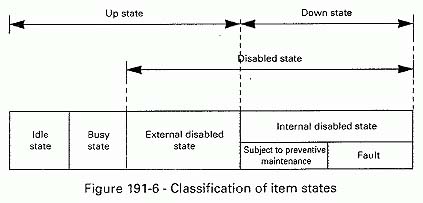
[IEV number 191-06-07]FR
état d'indisponibilité
état d'incapacité interne
état d'une entité caractérisé soit par une panne soit par l'inaptitude éventuelle à accomplir une fonction requise pendant l'entretien
NOTE 1 – Cet état est lié à la notion de disponibilité en tant qu'aptitude.
NOTE 2 – En français, l'adjectif "indisponible" qualifie une entité en état d'indisponibilité.
NOTE 3 – En français, dans le domaine des réseaux d'énergie électrique, le terme "état d'indisponibilité" désigne tout état d'incapacité et non seulement un état d'incapacité interne.
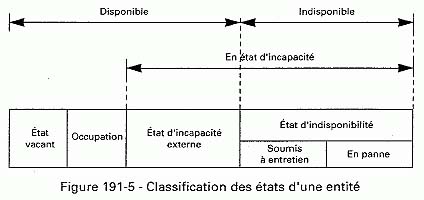
[IEV number 191-06-07]Тематики
- надежность, основные понятия
- тех. обсл. и ремонт средств электросвязи
Обобщающие термины
Синонимы
EN
DE
- nicht verfügbarer Zustand wegen interner Ursachen
- Unbrauchbarkeit wegen interner Ursachen
- Unklarzustand
FR
3.4 неработоспособное состояние (failed state): Состояние системы (элемента), в котором система (элемент) не исполняет требуемую функцию.
Примечание - Система может иметь несколько различных неработоспособных состояний.
Источник: ГОСТ Р 51901.15-2005: Менеджмент риска. Применение марковских методов оригинал документа
2.4. Неработоспособное состояние
Down state
Состояние объекта, при котором значение хотя бы одного параметра, характеризующего способность выполнять заданные функции, не соответствует требованиям нормативно-технической и (или) конструкторской (проектной) документации.
Примечание. Для сложных объектов возможно деление их неработоспособных состояний. При этом из множества неработоспособных состояний выделяют частично неработоспособные состояния, при которых объект способен частично выполнять требуемые функции
Источник: ГОСТ 27.002-89: Надежность в технике. Основные понятия. Термины и определения оригинал документа
Русско-английский словарь нормативно-технической терминологии > неработоспособное состояние
-
11 Относительно
The equation is solved for $y$Antisymmetric function with respect to $x$Measurable with respect to...A hypercomplex system over a commutative fieldThe algebra of square $ntimes n$ matrices with respect to the multiplication of matricesA finite limit with respect to the weak topologyMultiplication is distributive over addition in the set of natural numbersTo be symmetric with respect to...The position relative to the fixed axesThe error in $B$ with respect to $x$ is equal to...For the above reason, this term is called the condition number of $A$ with respect to inversionThe set of natural numbers is not closed under subtractionThe moment of inertia about two of the coordinate axesThis is a device that provides reactive force when in motion relative to the surrounding airРусско-английский словарь по прикладной математике и механике > Относительно
-
12 Однозначно сопоставляться
The function $H$ is uniquely associated to a vector field $v$Русско-английский словарь по прикладной математике и механике > Однозначно сопоставляться
-
13 Сопоставляется однозначно
The function $H$ is uniquely associated to a vector field...Русско-английский словарь по прикладной математике и механике > Сопоставляется однозначно
-
14 изображение
display, icon, image, ( на экране индикатора) paint, pattern, picture, representation, record кфт.* * *изображе́ние с.1. опт. imageизображе́ние ви́дно несовмещё́нным ( в дальномере) — the images are seen [appear] unmatched (in a range finder)восстана́вливать изображе́ние ( в голографии) — reconstruct the image (in holography)дава́ть перевё́рнутое изображе́ние — form an inverted imageдава́ть прямо́е изображе́ние — form an erect imageискажа́ть изображе́ние — distort the image(ме́тод) получе́ния изображе́ния — imageryнаблюда́ть изображе́ние — view the imageнакла́дывать одно́ изображе́ние на друго́е — superimpose two images [one image onto another]получа́ть изображе́ние чего-л. с по́мощью электро́нного луча́ — image smth. by [with] an electron beamпроеци́ровать изображе́ние на экра́не — project [throw] the image on the screenразвё́ртывать изображе́ние — scan the image [picture]изображе́ния слива́ются — (two) images fuse togetherслия́ние изображе́ний — the fusion of (two) images«сма́зать» изображе́ние ( в фотографии) — blur the picture [image]совмеща́ть (полови́нки или два) изображе́ния ( в дальномере) — match the imagesувели́чивать изображе́ние — blow up [enlarge, magnify] the imageуменьша́ть изображе́ние — reduce [scale down] the imageуменьша́ть изображе́ние (напр. в приборах электронного зондирования) — demagnify the imageчё́тко фокуси́ровать изображе́ние — bring the image into a sharp focus2. тлв. image, pictureизображе́ние сжа́то, напр. све́рху, сни́зу — the picture is cramped at, e. g., top, bottom3. рлк., осцил. representation, display, patternсмеща́ть [перемеща́ть] изображе́ние — shift the display [pattern]4. мат. representation; transformаксонометри́ческое изображе́ние — axonometric drawingви́димое изображе́ние — visible imageвнеосево́е изображе́ние — off-axis imageизображе́ние в рентге́новских луча́х — X-ray imageголографи́ческое изображе́ние — holographic imageграфи́ческое изображе́ние — graphic representationдвойно́е изображе́ние — double imageдействи́тельное изображе́ние — real imageдифракцио́нное изображе́ние — diffraction imageзерка́льное изображе́ние — mirror imageзерка́льное изображе́ние анте́нны — image antennaискажё́нное изображе́ние — distorted imageизображе́ние исто́чника — source imageизображе́ние исто́чника, зерка́льное — image sourceкартографи́ческое изображе́ние — cartographic(al) representationкванто́ванное изображе́ние по вре́мени — sampled pictureизображе́ние ко́да — code patternконгруэ́нтное изображе́ние — true-sided imageконтра́стное изображе́ние — contrast [hard] imageлапла́сово изображе́ние — Laplace transformнаходи́ть лапла́сово изображе́ние фу́нкции — apply the Laplace transform to a functionнаходи́ть оригина́л по лапла́сову изображе́нию — recover the original function from its Laplace transformоты́скивать лапла́сово изображе́ние фу́нкции — find the Laplace transform of a functionлате́нтное изображе́ние — latent imageмни́мое изображе́ние — virtual imageнегати́вное изображе́ние — negative imageнеконтра́стное изображе́ние — soft imageнеподви́жное изображе́ние1. тлв. static image2. рлк. stationary patternнечё́ткое изображе́ние — blind imageобра́тное изображе́ние — reversed [inverted] imageобъё́мное изображе́ние — stereoscopic picture, three-dimensional presentation, 3-d imageопти́ческое изображе́ние — optical imageоста́точное изображе́ние ( на ЭЛТ) — after-image, retained image, image retentionпараксиа́льное изображе́ние — paraxial imageперевё́рнутое изображе́ние — reversed [inverted] imageперспекти́вное изображе́ние — perspective, panorama [panoramic] sketchпобо́чное изображе́ние — false [ghost] imageпозити́вное изображе́ние — positive imageпо́лное изображе́ние — composite pictureполутенево́е изображе́ние — scale-of-gray [gray-scale] imageполуто́новое изображе́ние — half-tone image, half-tone pictureизображе́ние, полу́ченное шли́рен-ме́тодом — schlieren imageпростра́нственное изображе́ние — stereoscopic picture, three-dimensional presentation, 3-d imageпрямо́е изображе́ние1. опт. erect image2. полигр. direct copyрадиолокацио́нное изображе́ние — radar displayориенти́ровать радиолокацио́нное изображе́ние — orient [stabilize] the radar displayрадиолокацио́нное изображе́ние, ориенти́рованное относи́тельно и́стинного се́вера (меридиа́на) — north-(upwards-)stabilized [north-oriented, azimuth-stabilized] displayрадиолокацио́нное изображе́ние с ориента́цией по ку́рсу — heading-stabilized [vessel-oriented, relative] displayрадиолокацио́нное изображе́ние с ориента́цией по се́веру — north-(upwards-)stabilized [north-oriented, azimuth-stabilized] displayраздво́енное изображе́ние тлв. — split pictureразмы́тое изображе́ние — diffuse imageрасплы́вчатое изображе́ние — blurred imageра́стровое изображе́ние1. полигр. half-tone (photography), screening, half-tone reproduction2. свз. half-tone imageрасфокуси́рованное изображе́ние — out-of-focus [defocused] imageре́зкое изображе́ние — sharp [crisp] imageизображе́ние релье́фа — relief representationизображе́ние релье́фа, гипсометри́ческое — colour-relief presentation, graded coloring, tonal printingизображе́ние релье́фа, стереоскопи́ческое — stereoscopic relief presentationизображе́ние релье́фа, фотографи́ческое — gelatin relief imageсветлопо́льное изображе́ние ( микроскопа) — bright-field imageсере́бряное изображе́ние ( в фотографии) — silver imageскры́тое изображе́ние — latent imageсма́занное изображе́ние — smeared pictureизображе́ние с рва́ными края́ми — ragged pictureстереоскопи́ческое изображе́ние — stereoscopic picture, three-dimensional presentation, 3-d imageстигмати́ческое изображе́ние — stigmatic [punctual] imageстробоскопи́ческое изображе́ние — stroboscopic [frozen] imageсфери́ческое изображе́ние — spherical representationсфокуси́рованное изображе́ние — in focus imageсхемати́ческое изображе́ние — diagrammatic representation, sketchтемнопо́льное изображе́ние ( микроскопа) — dark-field imageтенево́е изображе́ние — shadowgraph, direct-shadow image, skiagraphтопографи́ческое изображе́ние — topographic(al) expression, representation of ground, terrain representationто́чечное изображе́ние — point imageтрёхме́рное изображе́ние — stereoscopic picture, three-dimensional presentation, 3-d imageизображе́ние усло́вными зна́ками — symbolizationфотографи́ческое изображе́ние — photographic imageфотоэлектростати́ческое изображе́ние — photoelectrostatic imageизображе́ние фу́нкции по Лапла́су — Laplace transform of a functionцветно́е изображе́ние — colour imageчё́рно-бе́лое изображе́ние — black-and-white pictureчё́ткое изображе́ние — sharp [crisp] imageчрезме́рно контра́стное изображе́ние — hard [harsh] imageштрихово́е изображе́ние — line imageэлектри́ческое изображе́ние — electrical imageэлектро́нное изображе́ние — electronic image -
15 область
area, circle, domain, field, island, range, territory, province горн., ( в базах данных) realm, region, scope, space, universe, zone* * *о́бласть ж.1. ( часть территории) area, region2. (отрасль знаний, деятельности науки и т. п.) fieldо́бласть ба́зы полупр. — base regionо́бласть высо́ких эне́ргий — high-energy regionо́бласть высо́кого барометри́ческого давле́ния — high, area of high pressure, anticycloneдовери́тельная о́бласть стат. — confidence intervalо́бласть допусти́мого режи́ма ( оптимизация процессов) — feasible areaо́бласть допусти́мых значе́нии, многосвя́зная — multiply connected feasible areaо́бласть дре́йфа элк. — drift spaceо́бласть ды́рочной проводи́мости полупр. — regionзапрещё́нная о́бласть физ. — forbidden regionо́бласть затво́ра полупр. — gate regionо́бласть значе́ний мат. — range (of values)о́бласть измене́ния значе́ний мат. — range, domainо́бласть интегри́рования — range [region, domain] of integrationинфракра́сная о́бласть — infra-red region, the infra-redинфракра́сная, бли́жняя о́бласть — near-infra-red region, the near-infra-redинфракра́сная, да́льняя о́бласть — far-infra-red region, the far-infra-redо́бласть D ионосфе́ры — D-regionо́бласть E ионосфе́ры — E-regionо́бласть ES ионосфе́ры — the sporadic E-regionо́бласть F ионосфе́ры — F-regionо́бласть исто́ка полупр. — source regionо́бласть колле́ктора полупр. — collector regionо́бласть лави́нного пробо́я элк. — avalanche regionо́бласть ми́нимума ( на вольтамперной характеристике туннельного диода) — valley regionо́бласть неприня́тия гипо́тезы мат. — (hypothesis-)rejection regionо́бласть непрозра́чности ( фильтра) элк. — stop-regionо́бласть неувере́нного приё́ма сигна́лов радио — marginal reception areaо́бласть ни́зкого барометри́ческого давле́ния — low, area of low pressure, cycloneобеднё́нная о́бласть полупр. — depletion layer, depletion regionо́бласть объё́много заря́да элк. — space-charge regionо́бласть определе́ния (напр. оператора) вчт. — domain of definitionо́бласть определе́ния фу́нкции мат. — domain of a function, the interval on which a function is definedо́бласть отрица́тельного сопротивле́ния — negative resistance regionо́бласть отсе́чки элк. — cut-off regionо́бласть перехо́да полупр. — transition [junction] regionо́бласть плохо́го приё́ма радио — poor reception [mush] areaпограни́чная о́бласть физ. — border zone, boundary regionо́бласть примене́ния — field of applicationо́бласть при́месной проводи́мости полупр. — extrinsic regionо́бласть приня́тия гипо́тезы мат. — (hypothesis-)acceptance regionо́бласть прозра́чности ( фильтра) — transmission band, transmission regionо́бласть пропорциона́льности1. ( в системах регулирования и приборах) proportionality band2. сопр. elastic rangeо́бласть простра́нственного заря́да элн. — space-charge regionо́бласть прямо́й проводи́мости полупр. — forward conduction regionо́бласть реа́ктора, запа́льная — (reactor) seed regionо́бласть синхрониза́ции элн. — locking rangeо́бласть со́бственной проводи́мости полупр. — intrinsic regionо́бласть спе́ктра — spectral regionо́бласть спе́ктра, ви́димая — visible spectrumо́бласть спе́ктра, инфракра́сная — infra-red spectrumо́бласть спе́ктра, опти́ческая — optical spectrumо́бласть спе́ктра, ультрафиоле́товая — ultra-violet spectrumо́бласть старе́ния метал. — ageing rangeо́бласть сходи́мости мат. — convergence setо́бласть температу́р превраще́ния метал. — transformation rangeо́бласть удержа́ния ( системы АПЧ) — hold-in rangeультрафиоле́товая о́бласть — ultra-violet region, the ultra-violetультрафиоле́товая, бли́жняя о́бласть — near-ultra-violet region, the near-ultra-violetо́бласть це́лостности мат. — domain of integrity, integral domainо́бласть чи́сел — number field, number domainо́бласть электро́нной проводи́мости полупр. — n -regionо́бласть эми́ттера полупр. — emitter regionэнергети́ческая, запрещё́нная о́бласть — forbidden band -
16 переключатель
selector switch, switch
электрическое устройство, служащее для соединения одного или нескольких проводников с любым из нескольких др. проводников, подключенных к устройству (переключателю). — а multiposition switch that permits one or more conductars to be connected to any of several other conductors.
- (кран переключения) — selector valve
-, барабанный (передней стойки шасси) — drum switch
- ввода информации (системы "омега" c положениями ппм, лбу, ветер и т.д.) — display selector switch (with wpt, хтк, wind, etc., positions)
- видов работ — function selector switch
- включения электропитания — on/off (power) switch sets the ons on or off.
- выбора индикации (на уви системы омега) — display selector switch (dss)
для выбора параметров, высвечиваемых на цифровом табло. положения: ппм, зпу/пу, зк/ус, ветер, мс, контроль и др. — selects data for presentation on the numerical displays. positions: wpt, хтк/тке, brg/dis, dsrtk/tk hdg/da, gs/ete, wind, pos, test.
-, галетный — wafer rotary selector switch
-, галетный (безразрывный) — wafer rotary selector switch (make before break)
-, галетный (с разрывом цепи перед включением) — wafer rotary selector switch (break before make)
- (выбора) двигателей при запуске — engine start selector valve
-, движковый (приводимый в действие большим пальцем руки) — thumb (-actuated) switch
-, двухгалетный — two-wafer rotary switch
-, двухпозиционный — two-position switch
- диапазонов (радио) — band selector switch
- динамики (ппд) — pitot selector valve
- дневного/ночного освещения — day/night switch
для регулирования яркости подсвета, — day/night switch is used to control brilliance.
-, жидкостной маятниковый (коррекции гироскопических приборов, напр., гпк) — liquid level switch
- зажигания — ignition switch
the ignition switch is set to "both" (l+2).
- индикации курса (сист. омега) — heading display selector switch with positions: mag, true.
- индикации расстояний (в мор, милях/км) и скоростей полета (в узлах/км) (сист. омега) — distance (nm/km) airspeed (knot/km) display selector switch
- кольцевания (питания двигателей топливом) — fuel cross-feed switch
- кольцевания (эл. шин) — (bus) crosstie switch
- коммутируемых в аппаратуре сопряжения сигналов (пульта выбора режимов сист. омега) — remote switch with positions: cmptr, ons 1, ons 2.
-, концевой (сигнализатор) — warning (limit) switch
- коррекции (магнитной и гпк) — mag-dg mode selector (switch)
-, кулачковый — cam actuated switch
- масштабов (рлс) — range switch
- масштабов и меток (рлс) — off-stby/range (selector) switc h
to provide range and range marker selection for indicator
- мэт (механизма эффекта триммирования) — trim switch
-, нажимной — momentary switch
-, нажимной замыкающий — momentary make (selector) switch
- однополюсный, на два направления (замыкающий) — single-pole double-throw switch (make)
- однополюсный, на два направления (с нажимным замыканием обоих направлений, с выключением в нейтральном положении) — single-pole double-throw switch (with both sides momentary make, center off)
- однополюсный, на два направления (с нажимным замыканием одного направления) — single-pole double-throw switch (with one side momentary make)
- "параметры" — data selector (switch)
- "параметры" (инерциальной сист.) — data selector
положения: ппм, ик/пг, soct/z, wc/yc, зпу/пу, soct/t, u/6 — positions: wpt, hdg/sts, dis/xtk, gs/da, d dis/time, wind
-, поворотный — rotary selector switch
-, полевой — field-effect switch
- попеременного включенияпереключения, нажимной, кнопочный — momentary alternate action pushbutton switch
- полярности зоны курсового маяка — то-from (localizer) selector switch
- ппм (промежут. пунктов маршрута) — wpt selector (switch)
- прд1-11(рлс) — xmtr 1-2 switch
- пределов (измерения, напр., вольтметра) — measurement range selector switch
- приемников воздушных давлений (пbд) — pitot/static tube selector
переключатепь на_два положения: основной и аварийный. — the pitot selector may be set to main or aux.
- радиосвязей (абонентского аппарата спу) — function (selector) switch
- радиосредств (абонентского аппарата спу) — function (selector) switch
- регулирования подсвета клавишного набора поля пуи (или уви) — cdu keyboard dimmer control switch. with positions, day, night
- режимов — mode selector switch
- режимов (работы системы омега) — automatic /manual/ remote switch, a/m/r mode (selector) switch
position оaп activates automatic sequential selection of route legs, position оmп entails manual selection of route legs, position оrп enables transmission and/or reception of specified data between systems such as dual ons, ins/ons, etc.
- режимов (автоматического радиокомпаса) — function switch
имеет следующие положения: выкл., комп., ант. и рамка. — the function switch of adf may be set to off, comp, ant, loop positions.
- режимов (пульта управления) — mode selector (switch)
- режимов рлс (гроза) с попожениями: готов, земля, метео, контур, контроль — mode selector switch positions: stby, terrain, weather, contour, test.
- режимов самолетного ответчика — transponder mode selector
для работы на внутренних и международных линиях, — position transponder selector to а (domestic) or в (international)
- рода работы — mode selector switch
- рода работы (арк) — (adf) function switch
- рода работы (на уви, с пожениями авт-ручн-контроль) — n&- function switch (auto) (а), man (м) and test (т) positions)
-, рычажный — toggle actuated selector switch
- с включением в среднем положении — switch with center on position
- с выключением в нейтральном (среднем) положении — switch with center off position
- с замкнутыми выводами в нейтрали — switch with center on position
- сигнализации остатка теплива и включения топливомера (указателя) наличия топлива в группах баков, — fuel low/quantity indicator switch. permits selective indication of fuel quantity and provides low level warning.
- с механическим включением — mechanically actuated switch
- с нажимным включением в крайних положениях — switch with momentary on at (both) extremes
- с разомкнутыми выводами в нейтрали — switch with center off position
- снятия усилий (на ручке управления циклическим шагом вертолета) — trim switch
- статики (системы пвд) — static (source) selector
- статики (системы пвд) — static (source) selector
"- статики" (надпись) — static
имеет два положения осн и авар. — may be set to normal or aux position.
- стояночного торможения — parking brake (park brake) switc h
- телефон - телеграф (тел тлг) — voice - c-w switch
- триммера (вертолета, на четыре направления - вправо, влево, вперед, назад) — (four-directional) trim switch (for lateral, fore-aft cycle)
- триммерного эффекта элеронов — aileron trim control switch.
вызывает смещение нейтрали загрузочного механизма элеронов, — movement of trim control switch shifts neutral position of the load feel mechanism.
-, четырехполюсный, на два положения — four-pole double-throw switch
-, четырехпозиционный с двумя контактами нажимного включения — four-position switch with 2 momentary contacts
- шин (эл.) устанавливать п. в (положение) — bus selector switch set the switch to (position)Русско-английский сборник авиационно-технических терминов > переключатель
-
17 генератор
( колебаний) driver, emitter, energizer, oscillator, generator, producer* * *генера́тор м.1. ( электромашинный) generatorвключа́ть генера́тор на нагру́зку — cause a generator to pick up (the) loadгенера́тор возбужда́ется — the generator builds upв слу́чае вы́хода генера́тора из стро́я … — upon loss of a generator …генера́тор выде́рживает нагру́зку (напр. номинальную) [m2]в тече́ние … — the generator carries its (e. g., rated) load for …генера́тор искри́т под щё́тками — the generator sparks under the brushesгенера́торы нагружа́ются равноме́рно ( при параллельной работе) — the generators divide the load wellгенера́тор нагру́жен норма́льно ( при параллельной работе) — the generator takes its share of loadгенера́тор начина́ет возбужда́ться — the generator picks upгенера́тор недогру́жен ( при параллельной работе) — the generator takes less than its share of the loadгенера́тор перегру́жен ( при параллельной работе) — the generator takes more than its share of the loadгенера́тор перехо́дит в режи́м электродви́гателя — the generator goes motoringгенера́тор рабо́тает на холосто́м ходу́ — the generator operates at no loadгенера́тор рабо́тает паралле́льно с … — the generator operates in parallel with …разгоня́ть генера́тор — allow a generator to come up to speed, bring up a generator to speedгенера́торы синхронизи́рованы ( при параллельной работе) — the generators are in synchronismсинхронизи́ровать генера́торы по загора́нию ламп — synchronize the generators by the light-lamp method, synchronize lightсинхронизи́ровать генера́торы по погаса́нию ламп — synchronize the generators by the dark-lamp method, synchronize darkста́вить генера́тор под нагру́зку — throw a generator on (the) load1) ( первичный источник колебаний) oscillator2) ( источник сигналов) generatorвозбужда́ть генера́тор — drive an oscillatorзапуска́ть генера́тор — activate [enable, turn on] an oscillatorнастра́ивать генера́тор измене́нием ё́мкости — tune an oscillator capacitively [by varying the tuned-circuit capacitance]настра́ивать генера́тор измене́нием индукти́вности — tune an oscillator inductively [by varying the tuned-circuit inductance]генера́тор начина́ет генери́ровать — the oscillator is kicked into oscillationsотключа́ть генера́тор — disable [turn off] an oscillatorпереводи́ть генера́тор в двухта́ктный режи́м — convert an oscillator to push-pull operationгенера́тор постро́ен на ла́мпе …— the oscillator uses [is based on, is built around] a … valveгенера́тор постро́ен по схе́ме (напр. ёмкостной трёхточки) — the oscillator is (set up as) a … (e. g., Colpitts circuit)генера́тор раска́чивается — the oscillator is building [builds] up (oscillation)синхронизи́ровать генера́тор какой-л. частото́й — lock an oscillator to a frequencyсрыва́ть колеба́ния в генера́торе — quench [turn off] an oscillatorавари́йный генера́тор — emergency generatorасинхро́нный генера́тор — induction generatorацетиле́новый генера́тор — acetylene generatorацетиле́новый генера́тор систе́мы «вода́ на карби́д» — water-to-carbide acetylene generatorацетиле́новый генера́тор систе́мы вытесне́ния — recession(-type) acetylene generatorацетиле́новый генера́тор систе́мы «карби́д в во́ду» — carbide-to-water acetylene generatorацетиле́новый генера́тор систе́мы погруже́ния — dipping(-type) acetylene generatorацетиле́новый генера́тор сухо́го ти́па — dry-residue acetylene generatorаэрозо́льный генера́тор — aerosol generator, foggerбала́нсный генера́тор — balanced oscillatorгенера́тор бегу́щей волны́ — traveling-wave-tube [TWT] oscillatorбесколле́кторный генера́тор — brushless generatorбесщё́точный генера́тор — brushless generatorгенера́тор бие́ний — beat-frequency oscillatorбрызгозащищё́нный [брызгонепроница́емый] генера́тор — splash-proof generatorгенера́тор Ван-де-Гра́афа — Van de Graaf [(electrostatic) belt] generatorвертика́льный генера́тор — vertical-shaft generatorгенера́тор видеочастоты́ — video-frequency signal generatorгенера́тор возбужда́ющих и́мпульсов — drive-pulse generator, driverвольтодоба́вочный генера́тор — booster (generator)вспомога́тельный генера́тор — auxiliary generatorгенера́тор вызывно́го то́ка — ringing generatorгенера́тор высо́кой частоты́1. (исходный или задающий источник в. ч. колебаний) radio-frequency oscillator2. (блок, включающий задающий в. ч. генератор, усилители, множители частоты и т. п.) radio-frequency generatorга́нновский генера́тор — Gunn(-effect) oscillatorгенера́тор гармо́ник ( не путать с генера́торами гармони́ческих или синусоида́льных колеба́ний) — harmonic generator (not to be confused with a harmonic or sinusoidal oscillator)гетерополя́рный генера́тор — cross-field [heteropolar] generatorгла́вный генера́тор мор. — propulsion generatorгенера́тор гла́вных синхронизи́рующих и́мпульсов — master clockгомополя́рный генера́тор — homopolar generatorгоризонта́льный генера́тор — horizontal-shaft generatorдвухко́нтурный генера́тор — tuned-input, tuned-output oscillatorдвухполя́рный генера́тор — bipolar generatorдвухта́ктный генера́тор — push-pull oscillatorджозефсо́новский генера́тор — Josephson sourceдиапазо́нный генера́тор — variable-frequency oscillator, VFOдинатро́нный генера́тор — dynatron oscillatorдугово́й генера́тор — arc converterё́мкостно-резисти́вный генера́тор — RC-oscillatorзадаю́ший генера́тор — master oscillatorгенера́тор заде́ржанных и́мпульсов — delayed pulse oscillatorгенера́тор заде́ржки — delay generatorгенера́тор за́днего полустро́ба — late-gate generatorзакры́тый генера́тор — (totally) enclosed generatorзапира́ющий генера́тор — blanking-pulse generatorзаря́дный генера́тор — charging generatorзвуково́й генера́тор — audio-signal [tone] generatorгенера́тор звуково́й частоты́ — audio-signal [tone] generator, audio(-frequency) oscillatorгенера́тор звуково́й частоты́, вызывно́й — voice-frequency ringing generator, low-frequency signalling setзу́ммерный генера́тор — buzzer oscillatorизмери́тельный генера́тор — ( без модуляции выходного сигнала) test oscillator; ( с модуляцией выходного сигнала) signal generatorгенера́тор и́мпульсного напряже́ния — high-voltage impulse generatorгенера́тор и́мпульсного то́ка — surge current generatorи́мпульсный генера́тор (источник колебаний, генерирующий под воздействием собственных или внешних импульсов) — pulse oscillatorи́мпульсный, хрони́рованный генера́тор — timed pulse oscillatorгенера́тор и́мпульсов (любой источник управляемых последовательностей импульсов, в том числе механический, электромеханический, электронный и т. п.) — pulse generator, pulserгенера́тор и́мпульсов за́данной фо́рмы — pulse waveform generatorгенера́тор и́мпульсов, маломо́щный — low-level pulserгенера́тор и́мпульсов, ма́тричный — matrix-type pulse generatorгенера́тор и́мпульсов, мо́щный — power pulserгенера́тор и́мпульсов, электро́нный — electronic pulse generatorгенера́тор инду́кторного вы́зова — subharmonic generator, ringing converterинду́кторный генера́тор — inductor generatorинтегра́льный генера́тор — integrated(-circuit) oscillatorинтерполяцио́нный генера́тор — interpolation oscillatorискрово́й генера́тор ( напр. для индукционного нагрева) — spark-gap converter (e. g., for induction heating)генера́тор ка́дровой развё́ртки — vertical-scanning [frame-scan, frame-sweep, vertical sweep] generator [circuit]калибро́вочный генера́тор — calibration oscillatorкамерто́нный генера́тор — tuning-fork oscillatorгенера́тор кача́ющейся частоты́ [ГКЧ] — sweep-frequency [swept-frequency] generator; ( без конкретизации типа) swept-signal sourceгенера́тор кача́ющейся частоты́ осуществля́ет кача́ние ( в пределах нужного диапазона) — the swept-frequency source sweeps (across the frequency range of interest)квадрату́рный генера́тор — quadrature oscillatorква́нтовый генера́тор — quantum-mechanical oscillatorква́нтовый генера́тор ИК-диапазо́на — infrared [IR] laser, iraserква́нтовый, опти́ческий генера́тор [ОКГ] — laser (см. тж. лазер)ква́нтовый, опти́ческий генера́тор бегу́щей волны́ — travelling wave laserква́нтовый, опти́ческий жи́дкостный генера́тор — liquid laserква́нтовый, опти́ческий и́мпульсный генера́тор — pulse(d) laserква́нтовый, опти́ческий инжекцио́нный генера́тор — injection laserква́нтовый, опти́ческий ио́нный генера́тор — ion(ic) (gas) laserква́нтовый, опти́ческий комбинацио́нный генера́тор — Raman laserква́нтовый, опти́ческий молекуля́рный генера́тор — molecular laserква́нтовый, опти́ческий монои́мпульсный генера́тор — giant-pulse laserква́нтовый, опти́ческий генера́тор на пигме́нтах — dye laserква́нтовый, опти́ческий генера́тор на руби́не — ruby laserква́нтовый, опти́ческий генера́тор на стекле́ с неоди́мом — Nd glass laserква́нтовый, опти́ческий полупроводнико́вый генера́тор — semiconduction laserква́нтовый, опти́ческий регенерати́вный генера́тор — cavity laserква́нтовый, опти́ческий генера́тор с модуля́цией добро́тности — Q-switched laserква́нтовый, опти́ческий генера́тор с непреры́вным режи́мом генера́ции — CW laserква́нтовый, опти́ческий генера́тор с электро́нной нака́чкой — electron-beam-pumped laserква́нтовый, опти́ческий твердоте́льный генера́тор — solid-state laserква́нтовый, опти́ческий хими́ческий генера́тор — chemical laserква́нтовый генера́тор СВЧ(-диапазо́на) — maser (см. тж. мазер)ква́нтовый генера́тор СВЧ, акусти́ческий — acoustic maserква́нтовый генера́тор СВЧ, га́зовый — gas maserква́нтовый генера́тор СВЧ, и́мпульсный — pulse(d) maserква́нтовый генера́тор СВЧ не аммиа́ке — ammonia gas maserква́нтовый генера́тор СВЧ на осно́ве циклотро́нного резона́нса — cyclotron resonance [electron cyclotron] maserква́нтовый генера́тор СВЧ на порошке́ — powder maserква́нтовый генера́тор СВЧ на пучке́ моле́кул — molecular-beam maserква́нтовый генера́тор СВЧ на руби́не — ruby maserква́нтовый генера́тор СВЧ, полупроводнико́вый — semiconductor maserква́нтовый генера́тор СВЧ, регенерати́вный — cavity maserква́нтовый генера́тор СВЧ, регенерати́вный отража́тельный — reflection-type cavity maserква́нтовый генера́тор СВЧ, регенерати́вныйпроходно́й генера́тор — transmission-type cavity maserква́нтовый генера́тор СВЧ, полупроводнико́вый — semiconductor maserква́нтовый генера́тор СВЧ с интерферо́метром Фабри́—Перо́ — Fabry-Perot maserква́нтовый генера́тор СВЧ с опти́ческой нака́чкой — optically pumped maserква́нтовый генера́тор СВЧ, твердоте́льный — solid-state maserква́нтовый генера́тор СВЧ, фоно́нный — phonon maserква́нтовый генера́тор с нака́чкой ла́зером — laser pumped maserква́нтовый генера́тор субмиллиметро́вого диапазо́на — submillimeter (wave) maser, smaserква́рцевый генера́тор — crystal oscillatorклистро́нный генера́тор1. (источник сигнала, подсоединён прямо к волноводу) klystron generator2. (источник высокочастотных колебаний, напр. гетеродин) klystron oscillatorкогере́нтный генера́тор — coherent oscillator, Cohoгенера́тор (колеба́ний) с вне́шним возбужде́нием — radio-frequency [r.f.] power amplifierкольцево́й генера́тор — ring oscillatorгенера́тор компенса́ции парази́тных сигна́лов передаю́щей тру́бки тлв. — shading generatorгенера́тор компенса́ции тё́много пятна́ тлв. — shading(-correction) generatorгенера́тор коро́тких и́мпульсов — narrow-pulse generatorла́мповый генера́тор — брит. valve oscillator; амер. vacuum-tube oscillatorгенера́тор лине́йно-возраста́ющего напряже́ния ( [m2]то́ка) — saw-tooth (voltage, current) generatorгенера́тор лине́йно-па́дающего напряже́ния ( [m2]то́ка) — phantastronмагнетро́нный генера́тор — magnetron oscillatorмагнитогидродинами́ческий генера́тор — magnetohydrodynamic [MHD] generator, magneto-fluid-dynamic [MFD] generatorмагнитогидродинами́ческий генера́тор на неравнове́сной пла́зме — non-equilibrium magnetohydrodynamic generatorмагнитострикцио́нный генера́тор — magnetostriction oscillatorмагнитоэлектри́ческий генера́тор — permanent-magnet generatorгенера́тор масшта́бных ме́ток да́льности — calibration mark(er) generatorгенера́тор ме́ток вре́мени — time-mark generatorгенера́тор ме́ток да́льности — range-mark(er) generatorмногото́ковый генера́тор — multiple-current generatorгенера́тор, модели́рующий диагра́мму напра́вленности — beam-pattern generatorмолекуля́рный генера́тор — molecular-beam maserнадтона́льный генера́тор (в синтезаторах частоты, возбудителях дискретного спектра и т. п.) — interpolation oscillatorгенера́тор нака́чки — pump oscillator; ( параметрического усилителя) pumpгенера́тор на кре́мниевом дио́де, транзи́сторах, R и C и т. п. — silicon-diode, transistor, RC-, etc. oscillatorгенера́тор на то́пливных элеме́нтах — fuel-cell generatorгенера́тор незатуха́ющих колеба́ний — continuous-wave [CW] oscillatorгенера́тор нейтро́нов — neutron generatorгенера́тор несу́щей частоты́ — ( в ВЧ телефонии) carrier oscillator; ( в системах на боковых частотах) carrier generatorнеявнопо́люсный генера́тор — implicit-pole generatorгенера́тор ни́зкой частоты́ — audio(-frequency) oscillator; audio signal generatorгенера́тор одино́чных и́мпульсов — single-pulse generatorопо́рный генера́тор ( в синтезаторах частоты и возбудителях дискретного спектра) — frequency standard (assembly)опо́рный генера́тор явля́ется исто́чником высокостаби́льной опо́рной частоты́, на осно́ве кото́рой получа́ются все остальны́е часто́ты, испо́льзуемые в радиоста́нции — the frequency standard produces an accurate, stable reference frequency upon which all frequencies used in the radio set are basedгенера́тор па́ра — steam generatorпараметри́ческий генера́тор — parametric oscillatorгенера́тор па́чек и́мпульсов — pulse-burst [series] generatorпеда́льный генера́тор — foot-operated [pedal] generatorгенера́тор пе́ны горн. — froth generatorгенера́тор пере́днего полустро́ба — early-gate generatorгенера́тор переме́нного то́ка — alternating current [a.c.] generator, alternatorгенера́тор переме́нного то́ка, многочасто́тный — multifrequency alternatorгенера́тор пилообра́зного напряже́ния ( [m2]то́ка) — saw-tooth voltage (current) generatorгенера́тор пла́вного диапазо́на — variable frequency oscillator, VFOпла́зменный генера́тор — plasma oscillatorгенера́тор пла́змы, дугово́й — arc plasma generatorгенера́тор повы́шенной частоты́ — rotary frequency changer, rotary changer converterгенера́тор погружно́го исполне́ния — submerged [submersible] generatorпогружно́й генера́тор — submerged [submersible] generatorгенера́тор постоя́нного то́ка — direct-current [d.c.] generatorгенера́тор по схе́ме ё́мкостной трёхто́чки — Colpitts oscillatorгенера́тор по схе́ме индукти́вной трёхто́чки — Hartley oscillatorгенера́тор по схе́ме моста́ Ви́на — Wien-bridge oscillatorгенера́тор по схе́ме Ше́мбеля — electron-coupled oscillator, ECOгенера́тор преры́вистого де́йствия — chopping oscillatorгенера́тор прямоуго́льных и́мпульсов — square-wave generatorгенера́тор псевдослуча́йной после́довательности — PR sequence generatorгенера́тор пусковы́х и́мпульсов — trigger(-pulse) generatorгенера́тор равновероя́тных цифр — equiprobable number generatorгенера́тор развё́ртки — брит. time-base (generator), time-base circuit; амер. sweep generatorгенера́тор развё́ртки да́льности — range-sweep generatorреакти́вный генера́тор — reluctance generatorрезе́рвный генера́тор — stand-by generatorрелаксацио́нный генера́тор — relaxation oscillatorгенера́тор релаксацио́нных колеба́ний — relaxation oscillatorреле́йный генера́тор — relay pulse generatorсамовозбужда́ющийся генера́тор — self-excited generatorсамохрони́рующийся генера́тор — self-pulsed oscillatorгенера́тор сантиметро́вого диапазо́на — SHF oscillatorгенера́тор с вну́тренней самовентиля́цией — built-in-fan-cooled generatorгенера́тор с водоро́дным охлажде́нием — hydrogen-cooled generatorгенера́тор СВЧ ( не путать с генера́тором сантиметро́вого диапазо́на) — microwave oscillator (not to be confused with SHF oscillator)сельси́нный генера́тор — synchro generatorгенера́тор се́тки часто́т — (frequency) spectrum generatorгенера́тор се́тки часто́т с ша́гом 10 кГц — a 10 kHz spectrum generatorгенера́тор сигна́лов — signal generatorгенера́тор сигна́лов, часто́тно-модули́рованный — FM signal generatorгенера́тор си́мволов — symbol generatorгенера́тор синусоида́льных колеба́ний ( не путать с генера́тором гармо́ник) — harmonic [sinusoidal] oscillator (not to be confused with harmonic generator)генера́тор синхрои́мпульсов тлв. — synchronizing(-signal) [sync] generatorсинхро́нный генера́тор1. эл. synchronous generator2. радио, тлв. locked oscillatorгенера́тор с и́скровым возбужде́нием — spark-excited oscillatorгенера́тор с ква́рцевой стабилиза́цией — crystal-controlled oscillatorгенера́тор с колеба́тельным ко́нтуром в цепи́ ано́да — брит. tuned-anode oscillator; амер. tuned-plate oscillatorгенера́тор с колеба́тельным ко́нтуром в цепи́ ано́да и се́тки — брит. tuned-anode, tuned-grid [TATG] oscillator; амер. tuned-grid, tuned-plate [TGTP] oscillatorгенера́тор с колеба́тельным ко́нтуром в цепи́ се́тки — tuned-grid oscillatorгенера́тор случа́йных сигна́лов ( в информационных системах) — random-signal generatorгенера́тор случа́йных собы́тий — random event generator, randomizerгенера́тор случа́йных чи́сел мат. — random number generator, randomizerгенера́тор с нару́жной самовентиля́цией — built-in blower-cooled generatorгенера́тор с незави́симым возбужде́нием1. эл. separately excited generator2. радио r.f. power amplifierгенера́тор с незави́симым охлажде́нием — separate fan-cooled generatorгенера́тор с непо́лным включе́нием колеба́тельного ко́нтура — tapped-down oscillatorгенера́тор с нея́вно вы́раженными полюса́ми — non-salient pole generatorгенера́тор со́бственных нужд (станции, подстанции и т. п.) — house generatorгенера́тор со скоростно́й модуля́цией — velocity-modulated oscillatorгенера́тор со сме́шанным возбужде́нием — compound generatorгенера́тор с отрица́тельной крутизно́й — negative-transconductance oscillatorгенера́тор с отрица́тельным сопротивле́нием — negative-resistance oscillatorгенера́тор с паралле́льным возбужде́нием — shunt(-wound) generatorгенера́тор с попере́чным по́лем — cross-field [heteropolar] generatorгенера́тор с после́довательным возбужде́нием — series(-wound) generatorгенера́тор с посторо́нним возбужде́нием — r.f. power amplifierгенера́тор с постоя́нными магни́тами — permanent magnet generatorгенера́тор с продо́льным по́лем — homopolar generatorгенера́тор с протяжё́нным взаимоде́йствием — extended interaction oscillatorгенера́тор срыва́ющей частоты́ — quench(ing) oscillatorгенера́тор с самовозбужде́нием ( автогенератор) — self-excited [feedback] oscillatorгенера́тор, стабилизи́рованный ква́рцем — crystal-controlled oscillatorгенера́тор, стабилизи́рованный ли́нией — line-controlled oscillatorгенера́тор станда́ртных сигна́лов — standard-signal generatorгенера́тор с тормозя́щим по́лем — retarding-field [positive-grid] oscillatorстоя́ночный генера́тор мор. — harbour generatorгенера́тор строб-и́мпульсов — gate generatorгенера́тор стро́чной развё́ртки — horizontal-scanning [line-scan, line-sweep, horizontal-sweep] generator [circuit]стру́йный генера́тор — fluid oscillatorгенера́тор ступе́нчатой фу́нкции — step-function generatorгенера́тор субгармо́ник — subharmonic generatorгенера́тор с фа́зовым сдви́гом — phase-shift oscillatorгенера́тор с часто́тной модуля́цией — frequency-modulated oscillatorгенера́тор с электро́нной перестро́йкой частоты́ — voltage-tuned oscillatorгенера́тор с я́вно вы́раженными по́люсами — salient-pole generatorгенера́тор та́ктовых и́мпульсов — clock pulse-generatorтахометри́ческий генера́тор — tacho(meter-)generatorтвердоте́льный генера́тор — solid-state oscillatorтеплово́й генера́тор — heat generatorтермоаэрозо́льный генера́тор — thermal aerosol generatorтермоэлектри́ческий генера́тор — thermoelectric generatorтермоэлектри́ческий, изото́пный генера́тор — isotopic thermoelectric generatorтермоэлектро́нный генера́тор — thermionic generator, thermionic converterтиратро́нный генера́тор — thyratron oscillatorгенера́тор тона́льного вы́зова — ( без конкретизации частоты) v.f. [voice-frequency] ringer; ( c точным указанием частоты) 2100-Hz ringer; 500-Hz ringerтранзитро́нный генера́тор — transitron oscillatorтрёхто́чечный генера́тор ( обобщённое название) — impedance voltage divider oscillatorтрёхто́чечный генера́тор с ё́мкостной обра́тной свя́зью — Colpitts oscillatorтрёхто́чечный генера́тор с индукти́вной обра́тной свя́зью — Hartley oscillatorтрёхфа́зный генера́тор — three-phase generatorгенера́тор уда́рного возбужде́ния — shock-excited oscillatorгенера́тор уда́рных волн ав. — shock-wave generatorгенера́тор у́зких строб-и́мпульсов — narrow gate [strobe-pulse] generatorу́ксусный генера́тор — vinegar generatorультразвуково́й генера́тор — ultrasonic generatorультразвуково́й генера́тор для сня́тия на́кипи — ultrasonic descalerуниполя́рный генера́тор — homopolar [unipolar] generatorгенера́тор, управля́емый напряже́нием — voltage-controlled oscillator, VCOфотоэлектри́ческий генера́тор — photoelectric generatorгенера́тор Хо́лла — Hall generatorгенера́тор хрони́рующий генера́тор — timing oscillatorгенера́тор чи́сел — number generatorгенера́тор ЧМ ( для измерений методом качающейся частоты) — sweep generator, swept-signal sourceгенера́тор широ́ких строб-и́мпульсов — wide gate [strob-pulse] generatorгенера́тор шу́ма — noise generatorэквивале́нтный генера́тор напряже́ния — constant-voltage generator (Thevenin equivalent)эквивале́нтный генера́тор то́ка — constant-current generator (Norton equivalent)электростати́ческий генера́тор — electrostatic generatorэлектростати́ческий, ле́нточный генера́тор — belt-type electrostatic generatorэлектростати́ческий, ро́торный генера́тор — rotary electrostatic generatorэлектрофо́рный генера́тор — influence machineэтало́нный генера́тор — reference [standard] oscillatorявнопо́люсный генера́тор — explicit-pole generator* * * -
18 служебная операция
1. bookkeepping operation2. bookkeeping operationоперация над строками; строковая операция — string operation
матричная операция; операция над матрицей — matrix operation
единичная операция; полудуплексная работа — single operation
финансовая операция, связанная с риском — venture operation
3. housekeeping operationполе кода операции; разряды кода операции — operation field
4. overhead operationоперация И; операция логического умножения — meet operation
матричная операция; операция над массивом — array operation
5. red-tape operation6. utility functionслужебная операция; функция полезности — utility function
Русско-английский большой базовый словарь > служебная операция
-
19 ход
course, ( доменной печи) drive, driving, excursion, computation line геод., line, ( механизма) move, movement, ( шагающих балок) pitch метал., run, process, route, running, stroke, (напр. поршня) throw, trace, tracing, traverse, way* * *ход м.1. ( движение) motion, move, movementво вре́мя хо́да су́дна — while the ship is underwayна ходу́ (напр. регулировать) — (e. g., adjust) on the goсвои́м хо́дом (о судне, автомобиле и т. п.) — under its own power3. (работа, эксплуатация) operation, service, actionпуска́ть в ход — put into operation, put into service, put into actionрабо́тать на холосто́м ходу́ — idle, run idle, run without loadсодержа́ть на ходу́ (напр. машины и т. п.) — keep (e. g., machines, etc.) in operation [in service, on the go]4. ( в теплообменном устройстве) pass5. (развитие чего-л.) progress, course6. ( скорость) rate, speed7. (место, через которое проходят) passage; ( вход) entrance, entry8. (изменение или характер изменения какой-л. физической величины, как правило, в зависимости от другой) behaviour, change, dependence, variation9. геод., топ. computation course, computation line, route, traverse10. (вид движения в транспортных средствах; существует только в сочетаниях с определяющими словами):на гу́сеничном ходу́ — on tracks, tracked, track-layingна колё́сном ходу́ — on wheels, wheeledазимута́льный ход — azimuth(al) motionход амортиза́тора — travelпри хо́де растяже́ния амортиза́тора — during extension …при хо́де сжа́тия амортиза́тора — during contraction …ход бата́на текст. — path of lay, stroke of latheход без толчко́в — smooth motionбесшу́мный ход — silent [noiseless] runningход вверх — upstroke, upward [ascending] strokeход вниз — downstroke, downward [inward, descending] strokeход впу́ска двс. — suction [admission, intake, charging] strokeвременно́й ход — time dependence, time variation, variation (of smth.) with timeход вса́сывания двс. — suction [admission, charging, intake] strokeход вы́пуска двс. — outstroke, exhaust strokeвысо́тный ход физ. — altitude curve, height dependence, altitudinal variationsдвойно́й ход — double strokeход до́менной пе́чи — run [operation] of a blast furnaceход зави́симости — variation, dependenceход зави́симости, напр. x от y — plot of x as a function of y, behaviour of x with (variations in) y, variations in x with yза́дний ход — reverse movement; reverse [backward] running; ж.-д. moving back, return motion; (поршня, ползуна) back strokeза́мкнутый ход геод. — closed circuitзо́льный ход кож. — line roundход иглы́ ( распылителя в топливной аппаратуре дизелей) — needle liftход каре́тки1. вчт. carriage movement2. текст. pitch of the coilход конта́ктов — contact travelход криво́й — ( имеется в виду кривая как таковая) trend [shape, run] of a curve; (имеется в виду какая-л. физическая величина, представленная кривой):ход криво́й ано́дного то́ка в зави́симости от се́точного напряже́ния пока́зывает, что … — a plot of anode current against grid voltage shows that …, the manner in which anode current varies with grid voltage shows that …, the behaviour of anode current with (variations in) grid voltage shows that …лесоспла́вный ход — floating routeли́тниковый ход — sprueход луча́ опт. — ray path (length)стро́ить ход луча́ — set up [trace] a rayмагистра́льный ход геод. — main [primary, principal] traverseма́лый ход мор. — low [slow] speedход маши́ны — machine runningмё́ртвый ход ( зазор в механизме) — backlash, lost motion, play, free travel, slackход нагнета́ния двс. — pressure strokeнеравноме́рный ход — irregular [discontinuous, uneven] runningнивели́рный ход — line of levels, level(ling) lineобра́тный ход — reverse [return] motion; reverse [backward] running; back strokeодина́рный ход — single strokeход педа́ли авто — pedal stroke, pedal travelход педа́ли сцепле́ния, свобо́дный — clutch pedal clearance, free travel of the clutch pedalпере́дний ход — forward motion; forward running; мор. advancing, aheadingперекидно́й ход ( коксовой печи) — cross-over flueход пе́чи — run [operation, working] of a furnaceрасстро́ить ход пе́чи — disturb [upset] the operation of a furnaceход пе́чи, горя́чий — hot run of a furnaceход пе́чи, неро́вный — erratic [irregular] operation of a furnaceход пе́чи, расстро́енный — disturbed operation of a furnaceход пе́чи, ро́вный — smooth [regular] operation of a furnaceход пе́чи, сты́лый — cold working of a furnaceход пе́чи, ти́хий — slow run [slow operation] of a furnaceход пе́чи, холо́дный — cold run of a furnaceход пилообра́зного напряже́ния элк. — stroke of a sawtooth voltageход пилообра́зного напряже́ния, обра́тный элк. — return stroke of a sawtooth voltageход пилообра́зного напряже́ния, прямо́й элк. — forward stroke of a sawtooth voltageход пилообра́зного напряже́ния, рабо́чий элк. — working stroke of a sawtooth voltageход пла́вки — progress of a heatпла́вный ход — smooth runningход плу́га — plough travel, plough draughtход подве́ски — suspension movementполигонометри́ческий ход — traverse, polygon(al) [polygonometric] traverse, polygonal courseпо́лный ход мор. — full speedрабо́чий ход двс. — working [power] strokeход развё́ртки (осциллоскопа, индикатора и т. п) — sweep motionход (развё́ртки), обра́тный — retrace (motion) of the sweep, flybackход (развё́ртки), прямо́й — forward motion of the sweep, active phase of the sweep scanход расшире́ния — двс. expansion [working, combustion, firing] stroke; ( амортизатора) extensionса́мый ма́лый ход мор. — dead slow speedса́мый по́лный ход мор. — flank speedсвобо́дный ход — free (easy) running, free travel; free wheelingход сжа́тия — compression [pressure] stroke; ( рессоры или пружины) bump stroke; ( амортизатора) contractionспоко́йный ход — smooth [quiet] runningсре́дний ход мор. — half [moderate] speedсу́точный ход — day [diurnal] variationсу́точный ход магни́тного склоне́ния — diurnal changes in magnetic variaticsтеодоли́тный ход — field [theodolite] traverseто́почный ход — (furnace) flueхолосто́й ход — idle [free, light, loose, no-load] running, idle [no-load] strokeпри холосто́м хо́де эл. — at no-loadход часо́в — daily rate (of a time niece)ход часо́в, отрица́тельный — rate of losingход часо́в, положи́тельный — rate of gainingчасто́тный ход (какой-л. физической величины) — variations with frequencyперепа́д мо́щности определя́ется часто́тным хо́дом перехо́дного ослабле́ния ответви́теля — the change in power is determined by variations in the dynamic attenuation of the coupler with frequencyчасто́тный ход оши́бки — the difference in error between the limiting frequenciesчасто́тный ход усиле́ния — plot of gain as a function of frequency, frequency dependence of gain, variations in gain with frequencyшу́мный ход — noisy runningход электро́нного луча́, обра́тный — flyback, return trace, retraceгаси́ть обра́тный ход электро́нного луча́ — eliminate [suppress, blank] the flyback [return trace, retrace]ход электро́нного луча́, обра́тный по вертика́ли — vertical flybackход электро́нного луча́, обра́тный по горизонта́ли — horizontal flybackход электро́нного луча́, обра́тный по ка́дру — frame flybackход электро́нного луча́, обра́тный по строке́ — line flybackход я́коря — armature travel -
20 цепь (электрическая)
circuit (cct)
ряд соединенных проводников для прохождения эл. тока. — а number of conductors connected together for the purpose of carrying an electrical current.
соединение нескольких устроиств, образующее один или несколько каналов (контуров) для выполнения определенных электрических или радиоэлектронных функций. — the interconnection of a number of devices in oле or more closed paths to perform а desired electrical or electronic function.
- блокировки (эл.) — interlocking circuit
цепь, в которой работа одного элемента эл. оборудования зависит от окончания срабатываний других элементов. — а circuit in which the орегation of one item of electric apparatus is made dependent on the fulfilment of certain predetermined conditions on other items.
- блокировки — lock-out /locking-out/ circuit
цепь, служащая для отключения и удержания в нерабочем состоянии устройства при нарушении его нормальной работы. — function is to shut down and hold а device out of service on occurence of abnormal conditions.
- взрыва (сро) — (trsp) destruct circuit
- включена (готова к работе) — circuit armed
- возбуждения (генератора, эл. мотора) — field circuit
- галля (роликовая) — roller chain
-, гальванически развязанная — decoupling circuit
а circuit used to prevent interaction of one circuit with anotheг.
- задержки (времени) — delay circuit
цепь, обеспечивающая задержку прохождения эл. сигнала no времени, — а circuit which delays the passage of а pulse or signal from one part of a circuit t another.
- зажигания — ignition circuit
-, замкнутая — closed circuit
эл. цепь, обеспечивающая протекание эл. тока при подаче напряжения (наличии разности потенциалов), — а complete electric circuit through which current may flow when а voltage is арplied.
-, кольцевая — loop circuit
энергопитание обеспечивается по раздельным многоканальным или кольцевым цепям. — electrical energy supply is ensured by means of multichannel or loop circuits separately routed.
-, коммутационная — switching circuit
-, контрольная — monitoring /monitor/ circuit
цепь прибора (или системы). контролирующая нормальную работу прибора, и вызывающая срабатывание устройств сигнализации отказа прибора или прекращения подачи питания. — monitor circuits defect a fault in a system.
- контроля, электронная — electronic monitoring circuit
электронная цепь контроля работы пилотажного командного прибора вызывает срабатывание (появление) блейкора красного цвета в случае неисправности (неправильногo показания) прибора. — the electronic monitoring circuits within the flight director deflect red warning flaps into view if a failure occurs that will cause incorreet display.
-, многоканальная — multi-channel circuit
- нагрузки — load circuit
цепь от источника питания до нагрузки (напр., эпектронная лампа эл. двигателя) — the complete circuit required to transfer power from а source to а load (e.g., electron tube, electric motor).
-, нарушенная (эл.) — open/ broken/ circuit
-, незамкнутая — open circuit
разомкнутая цепь, не обеспечивающая протекание эл. тока, — а circuit which does not provide а complete path for the flow of current.
- обратной связи — feedback circuit
- опроса (эвм) — sampling circuit
-, параллельная — parallel circuit
цепь, в которой все положительные и отрицательные вводы и выводы соединены в соответствующих общих точках, — а circuit in which all positive terminals and negative terminals are connected to their corresponding common points.
- питания — feed/ power supply/ circuit
-, последовательная — series circuit
цепь,в которой вывод одногo сопротивления (нагрузки) соединен с вводом следующего, и т.д. — а circuit in which resistance or other components are connected end to end.
- потребителя (эл.) — load circuit
- прохождения сигнала — signal flow circuit
-, разомкнутая (разорванная) — open/ broken/ circuit
-, роликовая — roller chain
- самоконтроля — self-test circuit
- связи (между системами, блоками) — coupling circuit
- соединения на — ground circuit
- управления — control circuit
-, швартовочная (груза в кабине) — (cargo) tie-down /anchoring chain
-, электрическая — electric circuit
-, электронная — electronic circuit
обрыв ц. — broken circuit
включать в ц. — connect in circuit
сопротивление, включенное в цепь, — а resistor is connected in circuit.
закреплять на ц. — chain
крышка закреплена цепочкой к горловине, — the cap is chained to the filler.
замыкать ц. — complete/ close/ circuit
реле замыкает цепь. защищать ц. с помощью аэс — the relay completes the circuits. protect circuit by circuit breaker
размыкать (разрывать) ц. — break/ open/ circuitРусско-английский сборник авиационно-технических терминов > цепь (электрическая)
- 1
- 2
См. также в других словарях:
Field emission — (FE) is the emission of electrons from the surface of a condensed phase into another phase due to the presence of high electric fields. In this phenomenon, electrons with energies below the Fermi level tunnel through the potential barrier at the… … Wikipedia
The Mote in God's Eye — … Wikipedia
field — field, domain, province, sphere, territory, bailiwick are comparable when they denote the limits in which a person, an institution, or a department of knowledge, of art, or of human endeavor appropriately or necessarily confines his or its… … New Dictionary of Synonyms
Field (physics) — The magnitude of an electric field surrounding two equally charged (repelling) particles. Brighter areas have a greater magnitude. The direction of the field is not visible … Wikipedia
function — n 1 Function, office, duty, province are comparable when they mean the act, acts, activities, or operations expected of a person or thing by virtue of his or its nature, structure, status, or position. Function is the most comprehensive of these… … New Dictionary of Synonyms
The Extended Mind — is a book in the field of philosophy of mind edited by Richard Menary. It contains several papers by different philosophers. The extended mind refers to an emerging concept that addresses the question as to the division point between the mind and … Wikipedia
field — [fēld] n. [ME feld < OE, akin to Ger feld, Du veld < IE * pelt < base * pele , * pla , flat and broad > L planus, plane, Gr palamē, flat hand] 1. a wide stretch of open land; plain 2. a piece of cleared land, set off or enclosed, for… … English World dictionary
Field capacity — is the amount of soil moisture or water content held in soil after excess water has drained away and the rate of downward movement has materially decreased, which usually takes place within 2–3 days after a rain or irrigation in pervious soils of … Wikipedia
The Space Trilogy — Out of the Silent Planet, Perelandra, That Hideous Strength Author Clive Staples Lewis Country United Kingdom Language … Wikipedia
The Grammar of Science — is a book by Karl Pearson first published at London by Walter Scott in 1892. It was recommended by Einstein to his friends of the Olympia Academy. Several themes were covered in this book that later became part of the theories of Einstein and… … Wikipedia
The Children of Húrin — … Wikipedia
